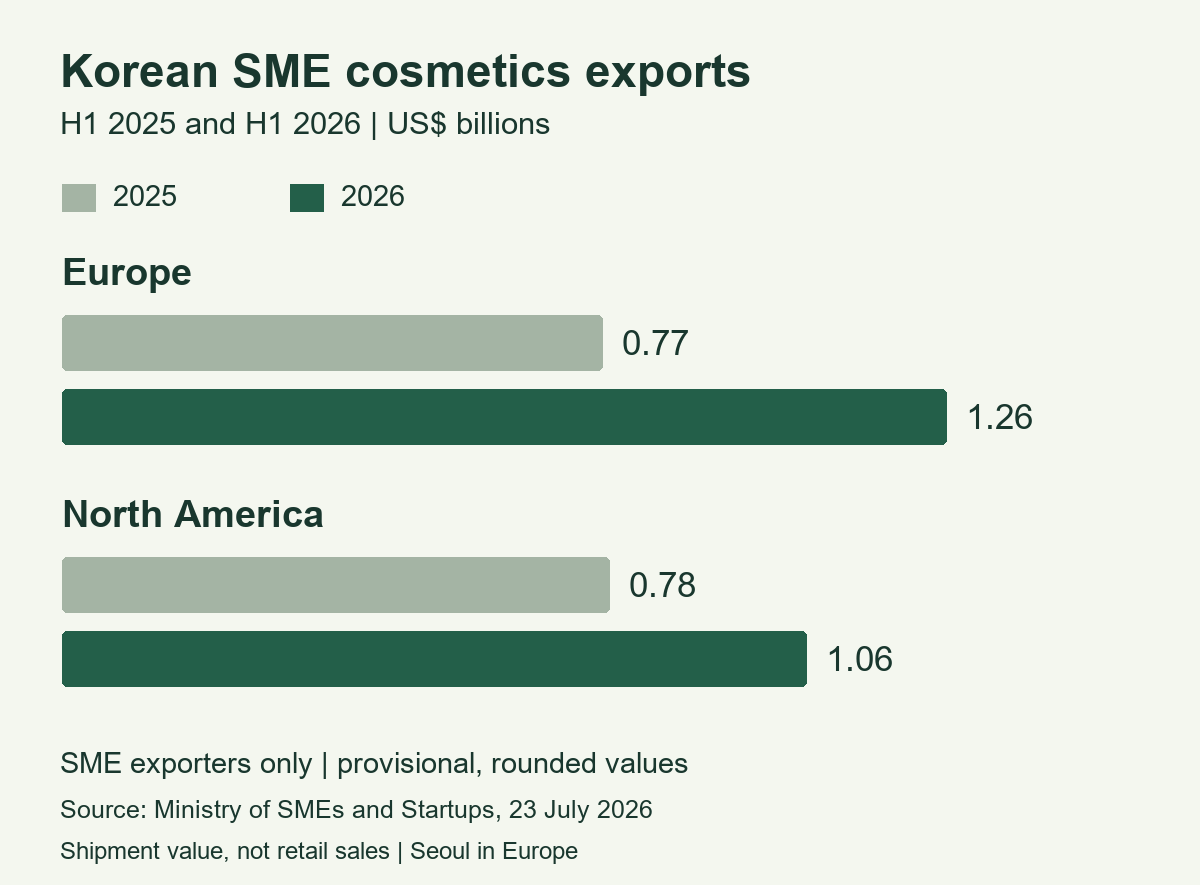
Korean beauty is reaching Europe through more than a few viral bottles. One useful sign comes from smaller Korean exporters: their cosmetics shipments to Europe rose 62.4% in the first half of 2026, ahead of the 36.8% growth recorded for North America in the same dataset.
That matters because many of the Korean brands appearing in overseas shops are not household names. A wider exporting base can give retailers more products to introduce. It does not tell us which serum a European shopper will finish and buy again, but it shows why Europe is attracting more attention from Korean beauty businesses.
The figures, with the same scope throughout
Korea’s Ministry of SMEs and Startups reported US$5.07 billion in cosmetics exports by small and medium-sized businesses in H1 2026, up 30.7% year on year. Its 23 July release gives the following regional figures. They cover SME exporters, not the entire Korean cosmetics industry, and remain provisional.
| SME cosmetics exports | H1 2025 | H1 2026 | Reported growth |
|---|---|---|---|
| Europe | US$0.77bn | US$1.26bn | 62.4% |
| North America | US$0.78bn | US$1.06bn | 36.8% |
The export values are rounded as in the ministry’s table; the growth rates come from its underlying figures. Europe is the ministry’s regional category, rather than a substitute name for the EU. All four values describe shipments across borders, not spending at beauty counters.
Why this differs from an all-industry headline
A headline about all Korean cosmetics exports can report a different total or a smaller regional gap. Large and medium-sized companies sit outside the SME group above. Changing the companies being counted changes the question the figures answer.
For this article, the useful finding is Europe’s growth within one clearly defined group. The figures do not need to become a claim that Europeans prefer K-beauty more than Americans do. A shipment can stock a distributor or a new shop; the data do not measure what happens after the stock arrives.
What a broader choice could look like
For shoppers, the interesting result would be more choice beyond the names that already dominate social media: different cleanser formats, moisturisers with a clear purpose, and brands whose appeal can be explained without a viral nickname. More choice helps when it fills a gap in an existing routine. Five almost identical hydration serums are less exciting than one option that suits a need previously overlooked.
Retail access is the next part of that story. The Aestura rollout at Sephora Europe is a separate example of a Korean brand reaching familiar shops; it is not evidence that Aestura belongs in this SME dataset. Our look at K-beauty’s next phase considers what makes those introductions useful to consumers.
I would welcome a shelf where an unfamiliar Korean brand is explained through the problem it helps with. A hydrating serum should be introduced as a hydration step; a scalp product should explain whether it cleanses or stays on the scalp. An export boom is more useful when it brings that kind of clarity, rather than another display labelled simply “K-beauty”.
The next sign worth watching
Initial shipments and lasting demand are different stages. Repeat retailer orders, products staying in stock and customers returning for another bottle would tell us more about whether the expansion is taking hold. Those results are not contained in the export table.
My reading is optimistic but specific: Europe has become a faster-growing destination for smaller Korean cosmetics exporters in this period. The opportunity is a broader, better-explained choice of products. The worthwhile finish to this story will be products people keep using, rather than a regional ranking that changes with the dataset.