PA++++ is the highest displayed Korean UVA grade, with a UVA protection factor of at least 16. The European UVA circle answers a different question: does the product meet the recommended minimum UVA protection relative to its SPF, alongside a requirement for breadth of coverage?
Those symbols are useful together, but they are not interchangeable certificates. For European readers shopping Korean sunscreen, understanding that difference is more useful than declaring one country's filters the winners.
SPF and PA measure different things
SPF measures protection against sunburn under test conditions, with UVB contributing most to that response. It is not a clock that gives you permission to stay outside for 50 times longer.
UVB is strongly associated with sunburn; UVA contributes to skin ageing. Both can damage skin. That is why an SPF number, which chiefly describes UVB protection, and a separate UVA indication answer different parts of the same protection question.
PA is a banded rating for UVA protection. Korea's MFDS explanation of the four-grade system sets out these thresholds:
| Label | UVA protection factor |
|---|---|
| PA+ | At least 2, below 4 |
| PA++ | At least 4, below 8 |
| PA+++ | At least 8, below 16 |
| PA++++ | At least 16 |
That last row is a floor, rather than a precise score. Two sunscreens can both say PA++++ while having different measured UVA protection factors. The four plus signs alone cannot rank them.
Similarly, SPF 50+ is a displayed category rather than a disclosure of the exact test result. Under the European Commission's labelling recommendation, the 50+ category starts at a measured SPF of 60. That European threshold should not be silently applied to every Korean-market label.
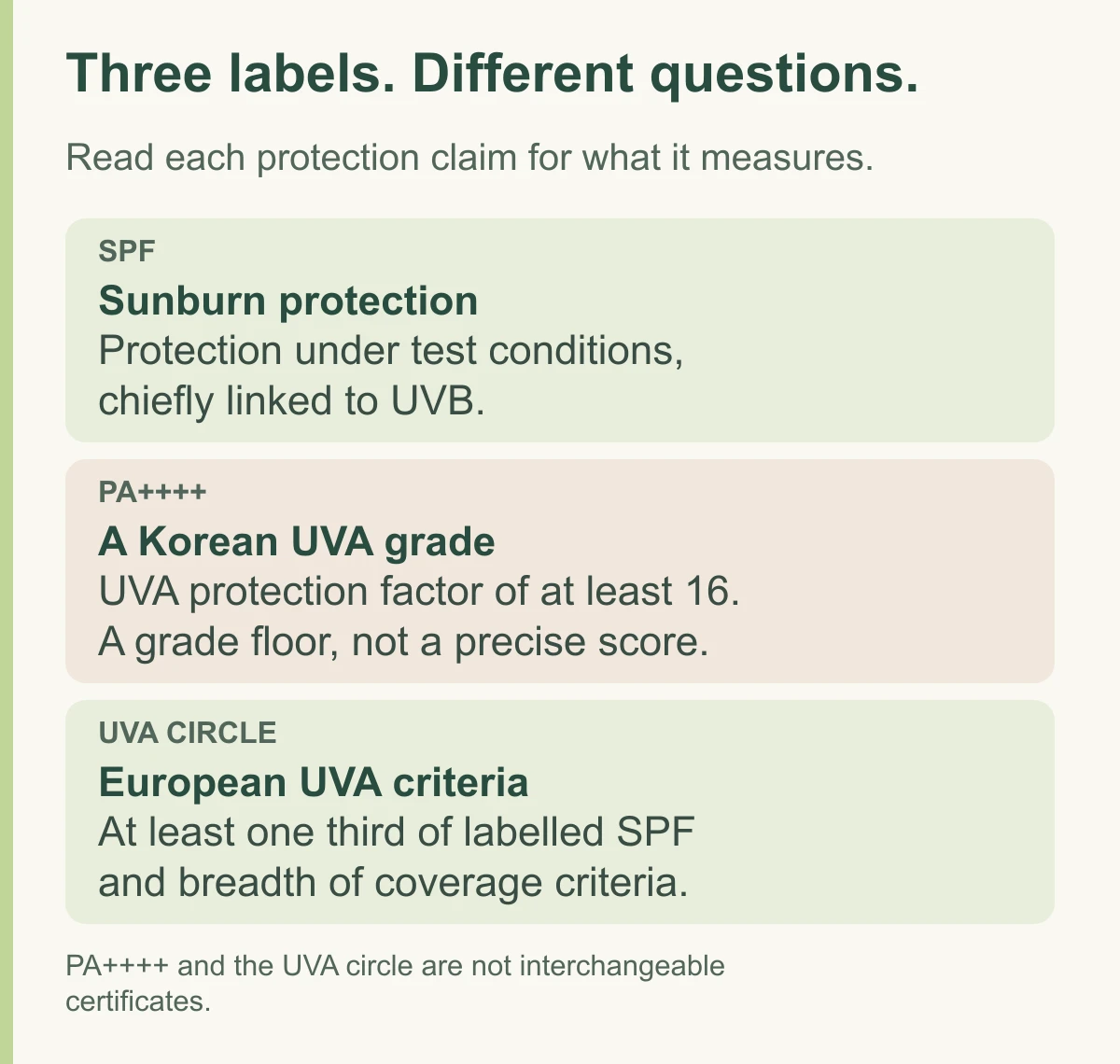
Why the UVA circle is not a translation of PA++++
The European recommendation calls for a UVA protection factor of at least one third of the labelled SPF and a critical wavelength of at least 370 nm. The latter describes the breadth of UV absorption, rather than giving a second strength score.
Cosmetics Europe's standardised circle logo indicates compliance with those recommended UVA criteria. It is not an additional PA grade.
A simple illustration shows why conversion is awkward. For a labelled SPF 30, the one-third criterion is 10. PA++++ starts at 16. But PA++++ by itself still does not establish the separate critical-wavelength criterion. These are different ways of describing protection, not two numbers you can swap without the rest of the test information.
My preference is to read each claim for what it actually tells me. “PA++++ equals the UVA circle” sounds convenient and loses a useful distinction.
Four filter names worth recognising
A filter's ingredient name and its supplier trade name can look like two different ingredients. These pairs refer to the same underlying filter:
| Ingredient-list name | Familiar trade name | Coverage role |
|---|---|---|
| Bis-Ethylhexyloxyphenol Methoxyphenyl Triazine | Tinosorb S | UVA and UVB |
| Methylene Bis-Benzotriazolyl Tetramethylbutylphenol | Tinosorb M | UVA and UVB |
| Diethylamino Hydroxybenzoyl Hexyl Benzoate | Uvinul A Plus | UVA |
| Ethylhexyl Triazone | Uvinul T 150 | UVB |
BASF's ingredient information supplies the INCI/trade-name mapping and filter roles. These are ingredients you may encounter in Korean formulas; the names are not a guarantee that a finished sunscreen has a particular SPF or UVA score.
The distinction also helps decode the 2026 bemotrizinol FDA decision: Tinosorb S and bemotrizinol should not be counted as two newly permitted filters.
Read protection and use separately
A combination of UVA and UVB filters explains the formulation's ingredients. The tested SPF and UVA claims explain its protection. The directions and any water-resistance claim explain how it is intended to be used around swimming or sweating.
Texture matters because you need to apply enough and reapply as directed. A pleasant daily sunscreen may be a sensible choice for ordinary wear without being the right product for a swim; the PA grade cannot decide that question.
The useful order is protection claims first, intended use next, ingredient names for context. A longer filter list is interesting formulation information, but it cannot do the job of the finished product's tests.