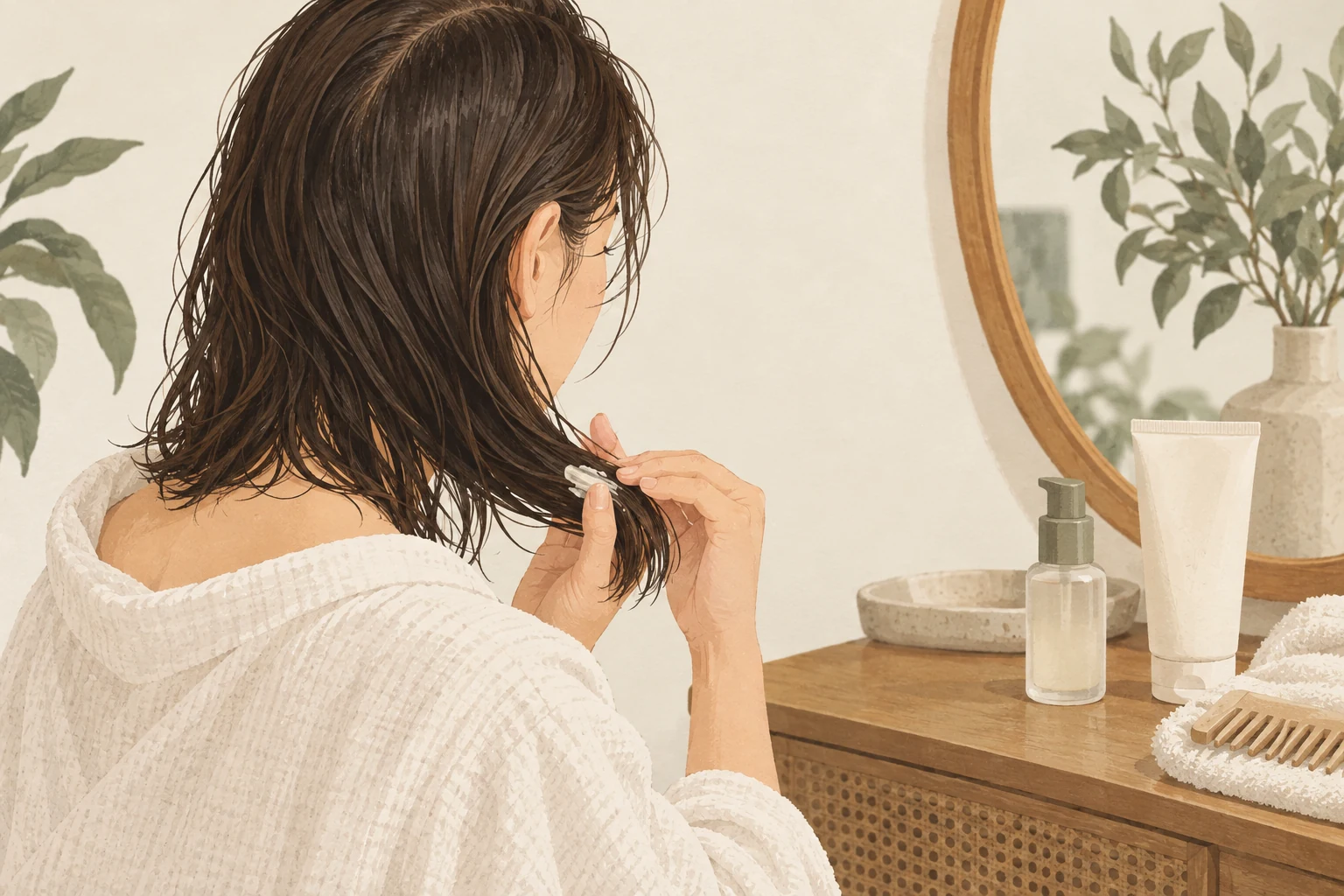
Hair essence usually means a leave-in product for the lengths of your hair. It might be a cream, a silky serum or an oil blend. If you are choosing between them, start with the moment you want help: getting damp hair ready to dry, or making dry ends look more polished.
For rough lengths before drying, I would look at a conditioning cream. For a small finishing touch on dry ends, I would look at a serum. You do not automatically need both, and an oil is not a separate step you must add after a serum.
I was told to apply the leave-in I used while my hair was still damp. Quite often, I remembered only after I had finished drying it. On the occasions I did use it, my hair felt noticeably softer. The benefit was easy to appreciate; remembering the right moment was the awkward part.
That is why I find the application stage more useful than the name on the bottle. Korean haircare labels overlap much more than a tidy “essence versus serum versus oil” chart suggests. Two products from mise en scène show why.
What does “hair essence” actually mean?
Mise en scène is a Korean haircare brand from Amorepacific. Its Perfect Base Up Essence is a cream-textured leave-in. You apply it to wet hair after shampooing and then dry your hair. Its Perfect Original Serum lists silicones alongside plant oils, including argan and jojoba. The brand's routine places that serum after drying as a shine finish.
So “essence” does not necessarily mean a watery liquid, and “serum” does not mean a formula without oil. If a bottle already combines oils and silicones, buying another oil simply because you think it completes the routine may duplicate the job.
The useful distinction is between a product you work through damp lengths and a product you use sparingly to finish dry hair. Some leave-ins can do both; others have a particular application method. There is no reason to make the routine longer just because the shelf has more names.
What the conditioning ingredients do
Silicones help give hair slip: strands slide past one another more easily, and the surface can look smoother and shinier. That is useful if your ends feel rough or catch when you comb them. Oils also contribute to the conditioning feel. A cream combines ingredients in a different format, rather than being an inherently stronger treatment.
Names such as dimethicone or dimethiconol are clues to that smoothing job. Cetyl alcohol and cetearyl alcohol, found in Base Up's list, are fatty alcohols used in conditioning formulas; they are not ethanol. These are ordinary formulation ingredients, not reasons to dismiss a product as “just chemicals.” The hair-cosmetics literature describes conditioning and leave-on products as ways to reduce friction and improve combing.
Easier combing and a smoother finish are useful results in their own right. That is what I would judge a leave-in on, rather than expect it to make damaged ends permanently new again.
Which format would I choose?
Fine hair that loses volume easily: start with one light leave-in and a small amount on the ends. My first adjustment would be the amount and placement, not adding another product. “Serum” on the label does not guarantee a weightless result, just as a cream label does not guarantee greasy hair.
Long, dry or chemically treated lengths: a conditioning cream before drying is a sensible starting point if the awkward part of your routine is working through rough hair. Base Up illustrates that type of product. I would try that step on its own before deciding whether the dry ends also need a serum.
Hair that feels manageable but looks fluffy at the ends: a little finishing serum is the more focused choice. Original Serum illustrates this role. Applying a small amount where the finish bothers you is more useful than coating the whole head because the bottle promises shine.
A perm or curls that need shape: decide whether you want softness or hold. A smoothing serum and a styling product are answering different questions. If the curl shape is the problem, piling on oil may give you more coating without the hold you wanted. I would choose a styling product for that job and keep extra conditioning modest.
These are starting choices, not a ranking in which cream is best for every dry head and serum is best for every fine one. The finish after your hair dries is the useful test of whether your choice and amount suit your routine.
Damp hair or dry hair?
For a cream intended before drying, get through the washing step first, remove excess dripping water and spread the product through the lengths. For a finishing serum, start with dry ends so you can see where you are putting it and whether it is already enough.
I would spread a small amount between my hands before applying it. Work on the lower lengths first, then use what remains on your hands where needed. Keep a smoothing leave-in away from the roots if those are already oily or easily flattened. A product for hair lengths is not a scalp tonic.
For a product you use before drying, keeping it beside the hairdryer is a practical reminder. If you regularly remember only once your hair is dry, a leave-in designed for dry-hair finishing may fit your habits better. Missing the damp-hair stage does not mean every leave-in is now off limits; it means the application instructions of the one you chose matter.
There is no universal number of pumps. Short fine hair and long thick hair need different amounts, and two pumps from different bottles can deliver very different quantities. Start below the amount you think you need; adding a little is easier than removing a heavy layer halfway through getting ready.
If the result looks greasy, change one thing next time: use less, move it farther down the lengths, or try it at a different permitted stage. Changing all three and adding an oil makes it harder to learn what helped. Nor would I treat a smoothing claim as automatic heat protection: choose a product with instructions for that particular job when using heat tools.
What if you would rather use a hair mask?
I've also been noticing hair masks such as fino more lately. That makes a different question worth asking: would you rather do the conditioning while you are already washing your hair?
Fino is a Japanese haircare brand. Its Premium Touch hair mask is a rinse-out treatment: apply it after shampooing, work it through the hair and rinse. A mask like this belongs to the washing stage, while the essences and serums above stay in the hair afterward. They are different routine formats, not a ladder in which the mask is automatically the stronger choice.
If remembering a separate pre-drying step is your main nuisance, a rinse-out mask might be easier to fit into the shower. If you mainly want to tidy the look of dry ends, a finishing serum answers that more directly. Choose the job you need before buying both. A mask that already leaves your hair comfortable and manageable is not a reason to add a leave-in automatically.
Choose the step you will actually use
My recommendation is to start with one format at the stage where your problem appears and where you will actually remember to use it. Choose a conditioning cream for work before drying, or a small serum finish for dry ends. If a rinse-out mask already does enough, stop there. The useful routine is the one that makes your hair easier to live with, without adding a step you keep forgetting.
The serum example
These are affiliate links. I may earn a commission if you buy through them, at no extra cost to you.
Mise-en-scène Perfect Serum Original 80ml at Olive Young Global is an example of the serum format discussed above. The listing has single and set options; choose the amount you need rather than assuming a larger set is part of the routine.