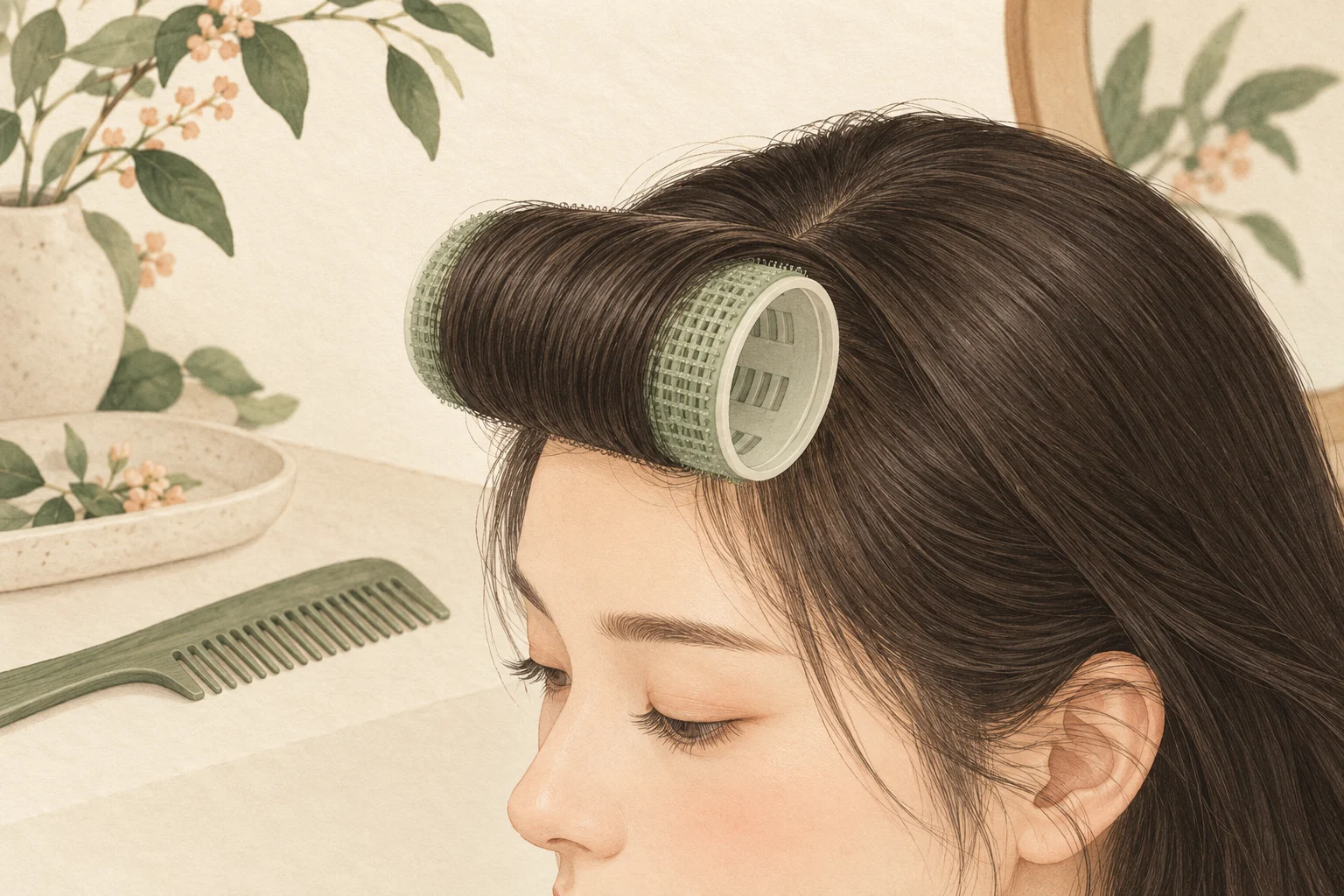
A fringe roller can give your bangs a temporary bend and some lift. If the roots remain flat while the tips curl sharply underneath, look at where the section sits on the roller. Wrapping only the ends cannot give the roots much help.
Start with a manageable, detangled section and a roller that lets it sit smoothly. The aim is to support the shape you want near the roots, then let the hair settle before you remove it gently.
I see these little rollers frequently in Korea, including on people heading out near home. Wearing one outside divides opinion: some see it as an ordinary part of getting ready, while others feel it should stay at home.
The styling appeal is easy to understand. You can leave one section setting while you do your makeup or get dressed. It is a small adjustment to the front of your hair rather than a whole-head styling session.
Root lift and curled ends are different results
Picture your fringe hanging straight down. Roll just its last few centimetres and you mainly change the curve at the bottom. That can create the round, tucked-under tip people often find too strong.
For a fuller shape, the part nearer the scalp also needs support. Lifting the roots while shaping the ends gives you a different result from curling just the tips underneath.
This is why copying the look of a roller in a photograph is less helpful than checking where your own hair is supported. Your fringe length, the direction it naturally falls and the amount wrapped around the roller all affect the shape you can make.
Choose a roller your section can actually wrap around
A small roller encourages a tighter curve. A larger one gives a broader bend, provided your hair is long enough to wrap around it properly. The largest roller in the shop is not automatically the best choice for short bangs.
Before rolling, separate the fringe from the longer hairs beside it. Comb the section until it is smooth. Stray long hairs winding around the sides make removal much more awkward than it needs to be.
Keep the section within the roller's working width. If hair spills over both ends, divide it instead of trying to squeeze everything onto one small cylinder. A smooth, controlled section is a better starting point than a bulky bundle.
For a fringe you want to curve underneath, lift the section away from your forehead and keep the ends together as you roll them towards the roots. Position it so the hair near the roots is supported as well as the ends, without pulling tightly on the scalp. If you are shaping longer curtain bangs away from the face, the direction changes with that intended shape. Decide where you want the section to fall before winding it.
Use it as a short styling step
Self-grip rollers can be used after blow-drying. With Drybar High Tops, for example, start with a smooth section, roll from the ends towards the base and leave the rollers in for ten to fifteen minutes. The brand recommends using them while the hair is still warm from a blowout.
That timing is for this product. Follow the instructions for your own roller and begin with a section and placement you can repeat comfortably.
An ordinary self-grip roller does not create heat by itself. A USB or other heated roller is a different device with its own instructions. Use the heating directions for the exact device you own.
You can fit a roller step around your makeup or getting dressed. If the result is worthwhile with that amount of effort, keep it. You do not need to turn a small fringe adjustment into a full-head roller routine.
Remove it by unwinding, not pulling down
Support the section and reverse the way you wound it. Work gently from the roller rather than dragging the whole thing through the hair like a brush. If a strand catches, stop and free it before continuing.
Once the roller is out, let the section fall, then separate it lightly with your fingers. A strong curled-under end may soften into a more wearable bend when you loosen the section. If the root is still flat, inspect the original placement before simply leaving the same roller in for longer next time.
If it keeps tangling, make the section smaller and neater, keep neighbouring hair clear and reconsider whether this self-grip surface suits your hair. A tool that is stressful to remove is not giving you a useful shortcut.
When would I bother with one?
I would try a fringe roller for a small, repeatable adjustment: lift at the front or a softer curve in bangs that hang too straight. A simple roller is an inexpensive way to see whether you like adding that shape to your routine.
For the most useful first attempt, concentrate on one section, a comfortable fit and smooth removal. If you get a lifted root and a gentle curve instead of a sharply hooked end, the roller is doing the job you wanted.