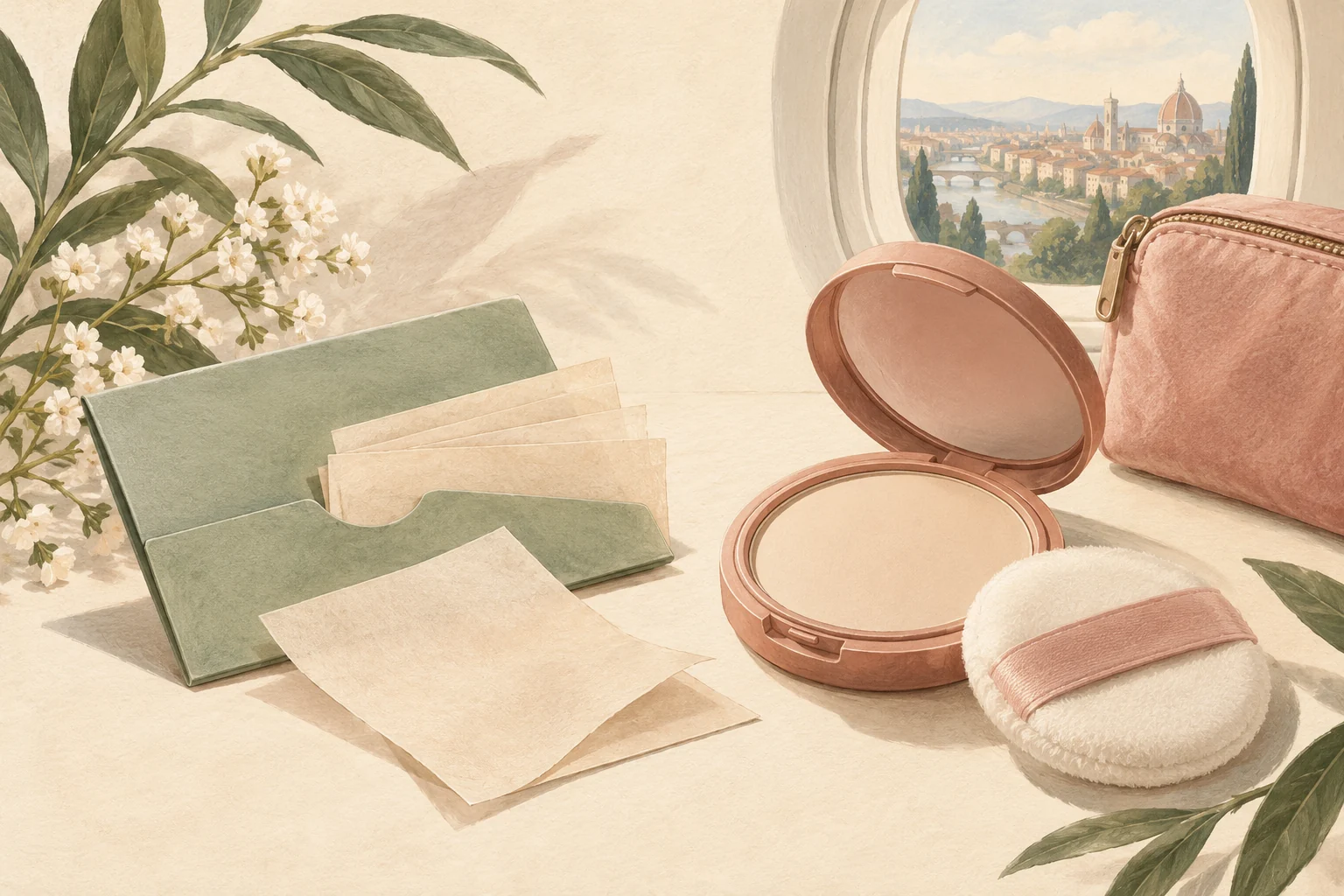
For a shiny nose halfway through the day, I'd start with plain blotting paper if the aim is to remove surface oil without putting on more makeup. Choose powder when you also want a more matte finish. If you need both, blot first, then press a little powder only where the shine still bothers you.
I pack blotting papers for long-haul flights. My skin is oily, and being able to press away the shine at my seat or in the lavatory is useful without turning it into a makeup session. That's the appeal of paper for me: sometimes I just want less oil on my face, not another layer on top.
What does “no-sebum” powder actually do?
Sebum is your skin's natural oil. A powder marketed as “no-sebum” helps manage the oil already on the surface and makes the skin look less shiny. The name isn't a promise that your skin will stop producing oil.
There's a useful expression behind some Korean products: oil-blotting powder. Korean beauty brand Innisfree uses it for its No-Sebum Mineral Powder. Think of it as a finishing product for oily areas, rather than a replacement for your skincare or a treatment for blocked pores.
Absorbent ingredients help with that job. Silica, for example, can take up liquids in cosmetic formulas. Powder also changes how the surface looks, giving a softer, more matte finish. That's why it can make the nose look tidier without adding the sort of coverage you'd get from foundation.
The distinction matters when shopping. A translucent finishing powder and a powder foundation may both come in round compacts, but one mainly adjusts the finish while the other also supplies pigment to cover the skin. If your foundation has worn off, a no-sebum powder won't put that colour back.
When blotting paper is the easier choice
Plain blotting papers lift away surface oil without leaving a deliberate layer of powder. I'd choose them for a light touch-up when the makeup underneath still looks good, or when I'm wearing no base makeup and simply want a less shiny forehead.
They're also a useful starting point if you like a dewy foundation. You can deal with oil around the nose while leaving the finish on your cheeks alone. There is no need to turn a deliberately glowy face completely matte because one small area has become greasy.
Use a fresh sheet and gently press it against the oily area for a few seconds, then lift it away. The American Academy of Dermatology recommends pressing rather than rubbing. Dragging a sheet around your face isn't the aim.
The small inconvenience is that papers are used up. A slim packet takes little space, but you'll need replacement sheets. For someone who only wants an occasional touch-up, I'd still start there before buying a powder, puff and brush.
When powder earns its place
Powder is more useful when the desired result is a matte finish, including when you're finishing your makeup in the morning. It can also help tidy a small shiny area later in the day, provided you don't keep adding it automatically over every existing layer.
Innisfree's No-Sebum range illustrates the format choice: it includes loose powder and a pressed Mineral Pact. The brand positions them for shine control and translucent finishing. For a bag, I'd favour a pressed compact for the simpler application. At home, loose powder gives you the option of dispensing a small amount before applying it.
Neither format wins by default. With loose powder, the practical issue is managing the amount and the container. With pressed powder, it's easy to keep loading the puff because picking it up feels so convenient. A small amount is still the better starting point for either.
“Translucent” also shouldn't be read as permission to pile it on. Look at the result on your own skin in daylight. If an area looks pale, dusty or more textured after application, adding another layer is unlikely to improve that finish.
For combination skin, I'd treat the nose and forehead separately from dry cheeks. You can want less shine in one place and more comfort in another. All-over powder isn't compulsory.
A touch-up that doesn't become another full face
If the skin is visibly oily and you want a matte finish, use this order:
- Gently blot the area, then look again. That may be enough.
- If coverage is missing, repair only that small patch with your usual base product.
- Press a little powder onto the areas where you still want less shine.
Blotting before adding powder is also the touch-up sequence in Revlon's makeup guidance. It gives you a chance to see how much correction is actually needed, rather than automatically covering the whole oily area with another coat.
If a cushion already looks thick before lunchtime, reconsider the amount used in the morning as well. Our guide to applying TIRTIR Red Cushion without a cakey finish deals with that earlier step. Midday powder can't undo an overly heavy base.
And a matte touch-up doesn't count as reapplying sunscreen. Choose your sun protection and reapplication method separately; neither ordinary blotting paper nor a finishing powder is a substitute.
What I'd put in the bag
For occasional shine with otherwise good makeup, plain blotting papers. For a consistently matte finish, a small pressed powder. For both heavy surface oil and a preference for matte makeup, papers first and a little powder afterwards.
If the skin looks comfortable after blotting, stop there. The best touch-up is the smallest one that gives you the finish you wanted.