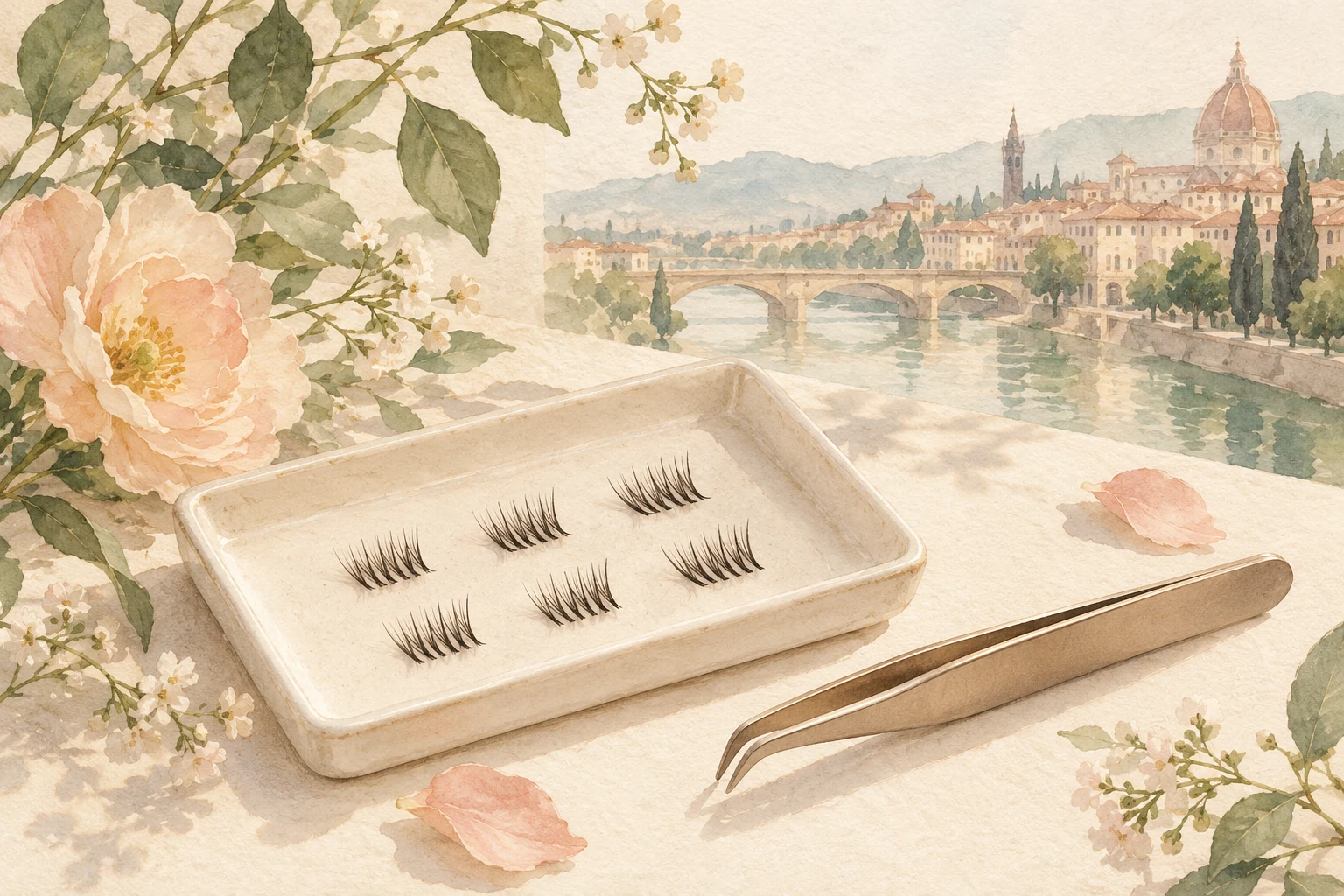
Korean no-glue lashes usually refer to self-adhesive false lashes: the adhesive is already on the lash base, so you do not apply a separate liquid glue. They can simplify that part of the process. You still have to choose a shape, place the lashes accurately and remove them as directed.
That makes “no-glue” an easy name to misunderstand. The practical change is where the adhesive sits before application, not a way for loose lashes to attach without anything holding them.
No separate glue, but still an adhesive
Korean lash brand CORINGCO sells no-glue lashes while also describing their slim glue line. Here, no-glue means the glue has been prepared on the lash base, ready for application.
You do not have to squeeze out liquid glue, judge how much to use or manage that glue on a separate lash strip. You do still have to handle and position the product. If placement is the part you find difficult, the name alone does not resolve it.
The shape matters as much as the adhesive
A full strip, a half lash and small clusters offer different styling choices. Clusters let you decide where to add emphasis, but that freedom also means deciding the spacing and length. A half lash makes a more limited change. Neither automatically produces the same result on different eye shapes.
Consider what you want to change in the first place. Is it extra length towards the outer corner, a few defined points through the lash line, or more overall fullness? Starting with that answer is more useful than choosing the longest option because the application sounds easier.
Look at the base as well as the fibres. If your aim is a barely noticeable addition, a close view of the attachment line is more useful than a photograph taken from across a room. You may like the overall lash pattern yet prefer to finish the base with eyeliner.
No-glue lashes, mascara and extensions do different jobs
Mascara coats the lashes already there. False lashes add fibres in a chosen arrangement. Salon extensions involve a different application and maintenance commitment.
This is why the trend makes most sense for someone who wants the appearance of added lashes but dislikes handling liquid adhesive. If mascara already gives you the finish you want, switching is not an obvious upgrade. If you enjoy changing the lash pattern for particular occasions, having the adhesive prepared may remove a bothersome step.
For the first attempt, leave time to practise rather than making the first application part of a rushed departure. Follow the placement and removal directions for the exact product. Different bases and formats should not be treated as interchangeable tutorials.
Easier application is not an allergy-free claim
Pre-applied adhesive is still adhesive. The FDA’s eye-cosmetic guidance explains that false lashes need adhesives and that the eye area can react to them. Keep hands and tools clean, stop if irritation occurs, and do not interpret no-glue wording as permission to ignore a previous adhesive reaction.
Likewise, a long-wear claim is not an instruction to sleep in the lashes or reuse them indefinitely. Use the wear, removal and reuse directions on the pack.
The appeal of Korean no-glue lashes is quite specific: one fiddly preparation step has been done for you. That can be a meaningful improvement. The best result still depends on choosing a lash pattern you actually want and finding an application you are comfortable doing.