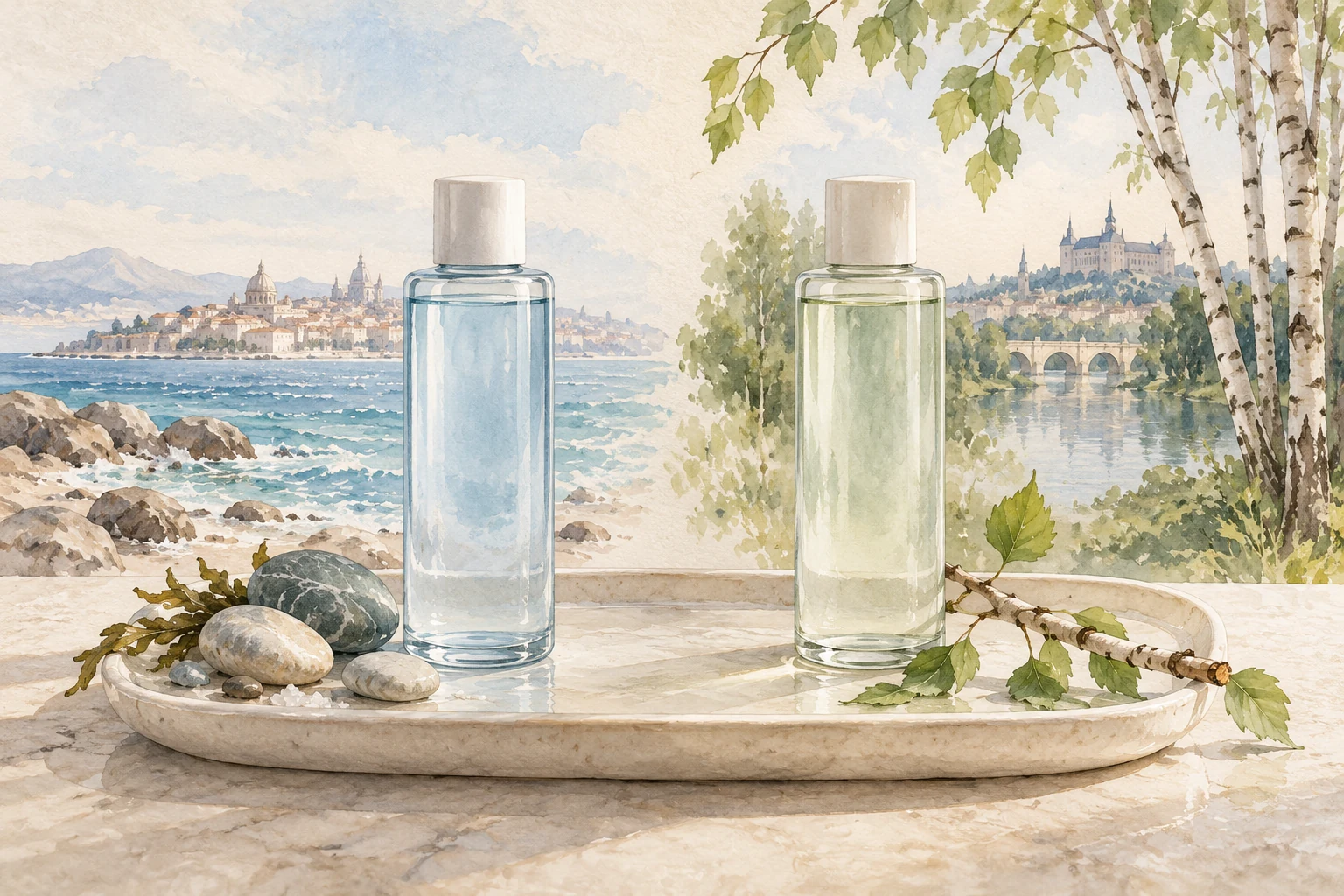
Round Lab's 1025 Dokdo Toner and Birch Moisturizing Toner are both watery, hydrating toners. Dokdo is the more straightforward shortlist if you want the brand's light, simple layer with its gentle texture-refining positioning. Birch is the more direct choice if you are looking specifically for a hydrating toner built around birch sap and hyaluronic-acid ingredients.
Dokdo also has a moisturising role. The two formulas overlap enough to compare them as alternatives, rather than assume you need a two-bottle sequence.
The landscapes are memorable; the formulas are more useful
Round Lab is a Korean skincare brand with ranges named around ingredients and places. Dokdo's sea-water identity and Birch's tree-sap identity make the bottles easy to remember. They are a starting point for understanding the ranges rather than a way to predict your skin's preference.
The current published Dokdo formula includes familiar moisturising ingredients such as glycerin and butylene glycol, alongside panthenol, betaine and allantoin. It also lists protease and has a brand description centred partly on gentle texture refinement.
Birch's published list includes birch sap, hyaluronic acid and sodium hyaluronate, along with other moisturising ingredients. The brand describes it as a watery toner with a dewy finish.
Those differences explain the emphasis of each bottle more clearly than an argument about whether the sea or a tree makes better water.
There is more overlap than the front labels suggest
Both published lists include panthenol, red-algae extract and sugarcane extract. Both also contain ingredients used to help keep a watery formula comfortable and hydrating on the skin.
That overlap matters if you are tempted to assign completely different jobs to them. Dokdo has a moisturising role as well as its texture-refining positioning. Birch is not the only one that can sit between cleansing and moisturiser.
The presence of sugarcane extract in an ingredient list also does not give you a stated concentration of glycolic acid. It would be a mistake to read either toner as a known-strength AHA treatment simply because sugarcane appears among its ingredients.
Likewise, a shorter ingredient list is a description of the formula, not proof that it will be gentler for every person. A relevant ingredient someone avoids matters more than winning a competition for the fewest names on the label.
Which difference matters in a routine?
For a very light toner step: Dokdo is a sensible starting comparison. Round Lab describes its texture as water-like and non-sticky. Its published formula gives a clear picture of a light moisturising layer without needing to turn the product into a strong exfoliating step.
I keep Dokdo Toner at home and use it from time to time. It can feel a little too light for what I want, but that same lightness is why I particularly like it in summer. That is the useful distinction for me: whether I want a barely-there toner or a more noticeable moisturising step.
For a toner with an explicit hyaluronic-acid brief: Birch is the clearer candidate. If that is the kind of hydration product you enjoy, its sap and hyaluronic-acid ingredients explain why it might appeal. The description still cannot guarantee exactly how much residue or dewiness you will feel under your own cream.
For skin that still feels uncomfortable after a toner: another toner may not be the missing piece. Consider the whole moisturising routine, especially the cream or lotion that follows. Two watery layers are not automatically a better answer than one followed by an appropriate moisturiser.
This is where personal preference can make a straightforward comparison more useful than a universal winner. Some people enjoy a watery step that seems to disappear quickly; others want it to leave a more noticeable moisturised feel before cream.
Applying the choice
Both are used after cleansing. Apply the amount directed for your selected bottle and continue with the rest of the routine. A cotton pad is a way of applying a toner, not a reason to rub harder or assume the product needs to remove visible skin to work.
There is also little benefit in buying both simply to cover the words *soothing* and *hydrating*. The formulas already overlap in those descriptions.
Choose Dokdo for its light, straightforward profile and texture-refining positioning; choose Birch when its particular hydrating formula is the attraction. The deciding factor is the specific toner step you want to use, based on the actual formula, rather than the bottle's aesthetic.