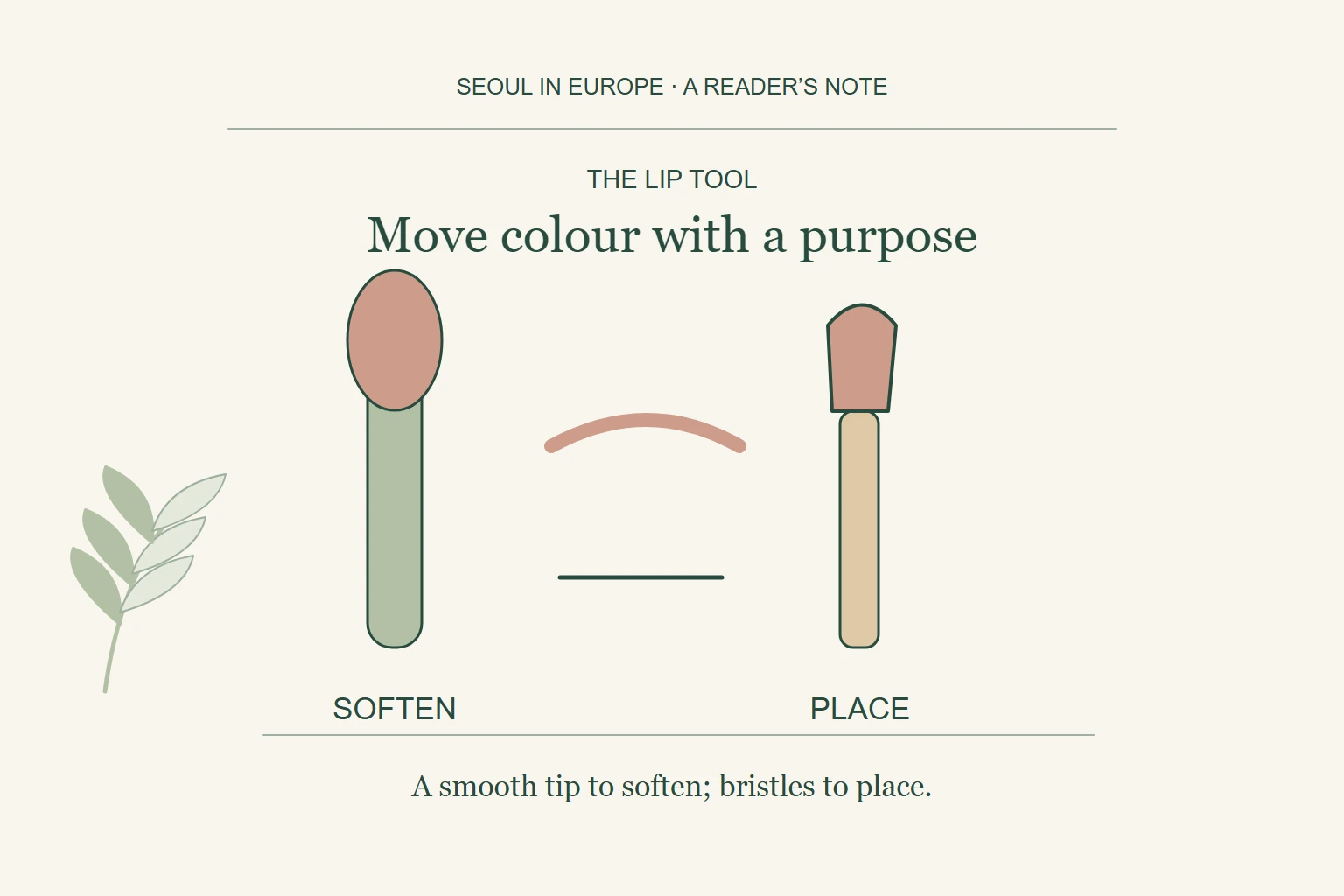
A silicone lip brush makes most sense when you want to move a little colour around: soften the edge of a tint, spread a balm, or blend two shades without using a fingertip. A bristled lip brush is useful when you want small, deliberate strokes.
The question is simple: Are you trying to make the border less obvious, or put colour exactly where it is missing? That gives a tool a job before it becomes another object to wash.
One colour, three different movements
Try this with a lip product you already know. Start with a little colour in the centre of the lip, keeping the amount modest enough to move.
Press and release. A clean fingertip can soften the transition with a few taps. It is the quickest option when you are happy with a broad, blurred edge. There is no separate handle to pack or clean, although your hands still need to be clean.
Spread with a smooth tip. Silicone applicators, such as the STUDIO17 Silicone Lip Brush, replace finger contact with a small, smooth surface. Use short movements at the border rather than repeatedly dragging product from one corner to the other. The appeal is control over where the colour moves, especially when a finger feels too large for the area.
Place with bristles. A conventional lip brush, such as PICCASSO's 501 Lip, gives you a different set of marks. You can work into the corners or add colour along a chosen outline. It can also blend, but precision is a good reason to choose it over a smooth paddle.
These are different ways of moving the same colour, not a promised before-and-after result. A wet gloss and a tint that has already set will behave differently under the same tool.
Blend before the formula stops moving
If a tint has become patchy, another minute of brushing may simply disturb the patch more. Apply less at the start and work while the product is still movable. For a glossy formula, small taps can preserve more of the surface than a long swipe.
A softer border also does not require a bare centre. You can keep the colour stronger inside the lip and soften only the outer transition. That is often a clearer aim than trying to make the whole application look equally faint.
If you already like the result from the product's own applicator, keep using it. An extra brush earns its place when the supplied tip is awkward for a particular corner, edge or blend.
The cleaning step comes with the handle
A smooth tip can be easy to inspect for leftover colour, but silicone is not automatically self-cleaning. Remove residue, clean the tool according to its care directions and let it dry before putting its cover back on. Bristles need the same attention, including the part near the base where product can collect.
Keep a tool used on the lips for that purpose rather than moving it between lips and eyes. Avoid returning a used applicator to a shared product.
For a bag, the most useful feature may be a cover that protects a clean, dry tip. For the bathroom, it may be how easy the brush is to wash. Those details affect whether an extra tool stays convenient.
Choose silicone for a small surface to spread and soften; choose bristles for strokes and placement. And if a clean fingertip already gives you the edge you want, the sensible purchase may be no brush at all.