For an everyday hydration layer, I would put a clearly identified snail essence ahead of a vague “regeneration” product. For fine lines, a PDRN formula with relevant topical evidence is more interesting to investigate. Exosomes would be lower on my shortlist while commercial products disclose so little about the material inside. That is my practical reading of three different skincare propositions.
My view is that these names have become more impressive than the distinctions underneath them. Snail mucin sounds familiar; DNA fragments and cellular messengers sound advanced. A newer-sounding ingredient does not automatically make the better everyday cosmetic.
What each name actually describes
| Name | What it refers to | What the name alone cannot tell you |
|---|---|---|
| Snail mucin | Snail-derived secretion material, usually listed as Snail Secretion Filtrate | The performance or tolerance of every essence containing it |
| PDRN | A preparation of DNA fragments; short for polydeoxyribonucleotide | Whether a serum matches the preparation, concentration or delivery method in a study |
| Exosomes | Small vesicles released by cells, carrying biological material | The source, processing, stability or clinical performance of the vesicles in a particular cosmetic |
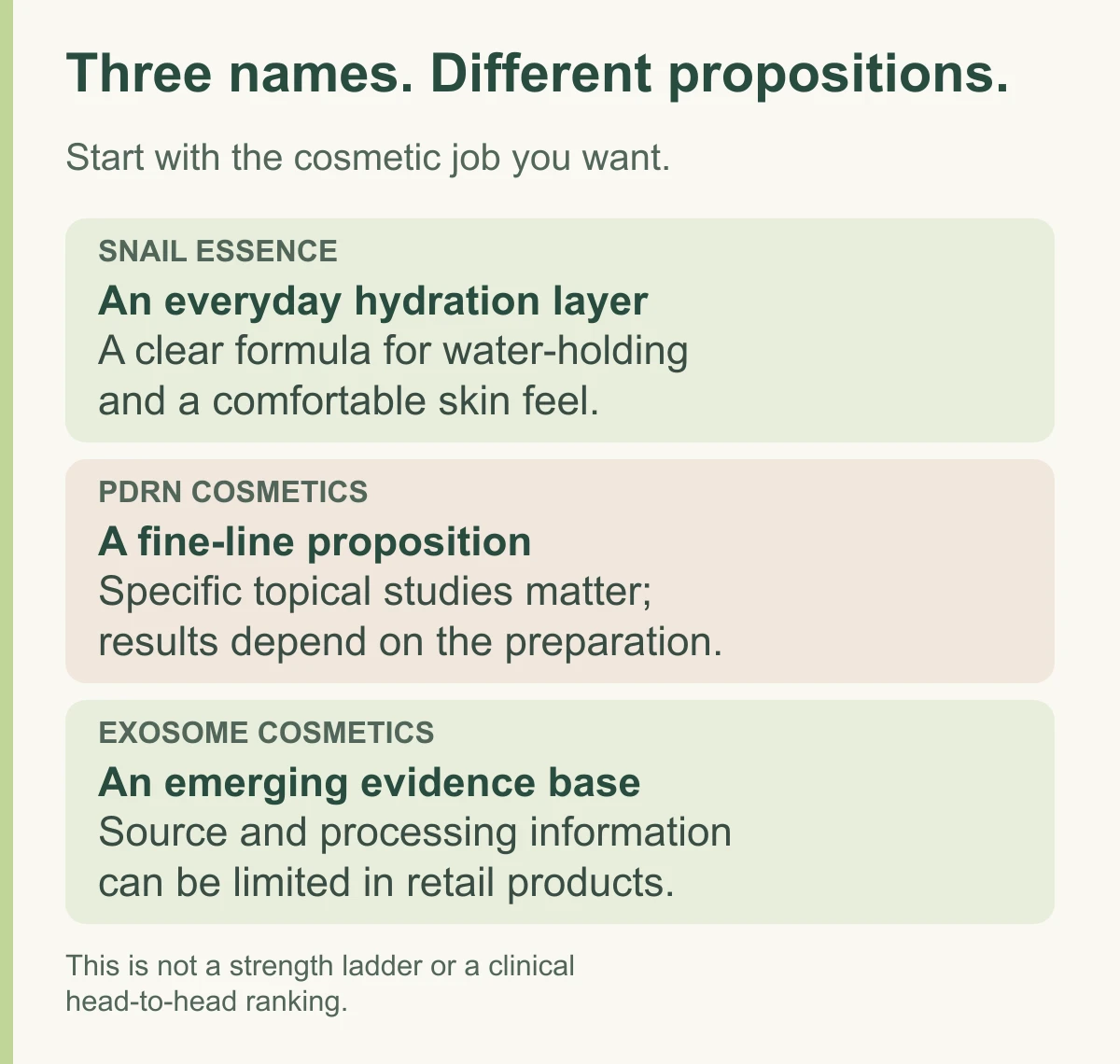
In everyday terms, snail products are mainly appealing for hydration and a comfortable skin feel. PDRN cosmetics often target plumper-looking skin and fine lines. Exosome skincare is marketed around recovery and texture, but the evidence for ordinary topical products is still emerging. These are different aims with different levels of support, not three grades of the same ‘repair’ ingredient.
A useful comparison is possible once the goal is clear. Snail essence is the straightforward hydration option here. PDRN asks you to consider a more specific fine-line proposition. Exosomes ask for more confidence in a much less transparent product category. Those differences help set a shopping priority without claiming a universal clinical winner.
Snail essence: a concrete formula rather than a regeneration story
COSRX is a Korean skincare brand, and its Advanced Snail 96 Mucin Power Essence is a useful example because the formula is clearly identified. The brand lists 96.3% snail secretion filtrate, alongside ingredients including betaine, sodium hyaluronate, panthenol and allantoin.
That makes hydration a sensible way to understand this particular essence. The 96.3% describes filtrate, not 96.3% of one purified active ingredient. It cannot be compared directly with a PDRN percentage as a score for strength.
Snail origin is also a straightforward preference question: this is an animal-derived material. Someone avoiding it does not need an elaborate effectiveness debate to choose another hydrating formula. Nor does choosing it commit you to adding PDRN next.
PDRN: the route of use changes the question
PN and PDRN have been studied in injections, wound care and procedures as well as topical products. Those settings use different preparations and delivery methods, so I would base a cosmetic choice on evidence for application to ordinary intact skin.
This is not a reason to dismiss topical research. A separate 2026 PLOS One study tested a specific 0.1% PDRN-850K eye cream in 31 women for 28 days and reported improvements in measured eye-area wrinkle and skin-structure parameters. The authors also acknowledged that early changes may partly reflect hydration or plumping and that longer studies are needed.
That is more relevant to a cosmetic than borrowing an injection result. It is still evidence about one preparation in one formula over a short period, not a guarantee for every bottle labelled PDRN. Our PDRN skincare guide explores that distinction further.
Exosomes: there is topical research, with substantial variation
Calling exosomes cellular messengers explains why researchers study them. It does not establish that every exosome cream delivers the same material in the same condition.
A 2026 scoping review identified 18 human studies of topical exosomes: ten used additional delivery methods, while eight examined topical application alone. So “there are no topical studies” would be too strong. Equally, results involving a delivery procedure should not automatically become the expected result of smoothing on a cream.
The review also examined 20 commercial products and found limited information about isolation, processing and shelf life. Those gaps matter: the word on the jar does not reveal whether its contents match the material used in a promising study. This is a developing evidence base, not a settled league table of creams.
Choose the job, then the formula
If my main complaint was tight, dehydrated-feeling skin, the snail essence would be my first option to inspect. If it was fine lines and I wanted to explore a newer ingredient, I would look for a PDRN product with a clear topical study. I would pass over an exosome cream whose main argument was “cellular repair” without useful product evidence. Newer is interesting; a clearer reason to choose it is more persuasive.
These are affiliate links. If you buy through them, I may earn a commission at no extra cost to you.
Browse COSRX’s range at Olive Young Global. This opens the brand selection, not one specific Snail 96 bottle.
For the specific snail example, COSRX Advanced Snail 96 Mucin Power Essence 100 ml at Olive Young Global is the essence discussed above.
You do not need all three categories to make a complete routine. A formula that meets a real need is a better choice than a label that merely sounds like the next generation. The upgrade worth having is a better fit for your skin, not a more futuristic ingredient name.