PDRN skincare now has a more interesting question than whether a serum can copy an injection. A 2026 study tested a PDRN eye cream directly against a retinol eye cream and reported encouraging results. The detail worth reading is what those creams, participants and four weeks of testing actually establish.
If the number on a PDRN product is your next question, our ppm concentration guide explains what that figure can tell you.
For someone interested in fine-line care, this gives topical PDRN a reason to be on the research shortlist: a defined cream was tested on the eye area, rather than inferred from an injection. I would still ask for evidence on the product I planned to buy, and would not replace a comfortable, effective retinoid routine on the strength of this one short trial.
What PDRN means here
PDRN stands for polydeoxyribonucleotide: a preparation of DNA fragments. The material in this study came from salmon and was described as PDRN-850K, with a specified molecular profile. That is a more precise description than “salmon DNA” on a skincare headline.
Why is it used? Cosmetic brands generally position PDRN for plumper-looking skin, firmness and the appearance of fine lines. For a reader, that means asking about visible results from a cream or serum over time. It does not mean that putting DNA fragments on your face gives you the results of a clinic procedure. The topical study below is useful precisely because it tested a defined cream, not just an impressive-sounding ingredient.
If you are deciding between ingredient trends, PDRN, snail mucin and exosomes compared separates their different roles rather than treating them as an upgrade ladder.
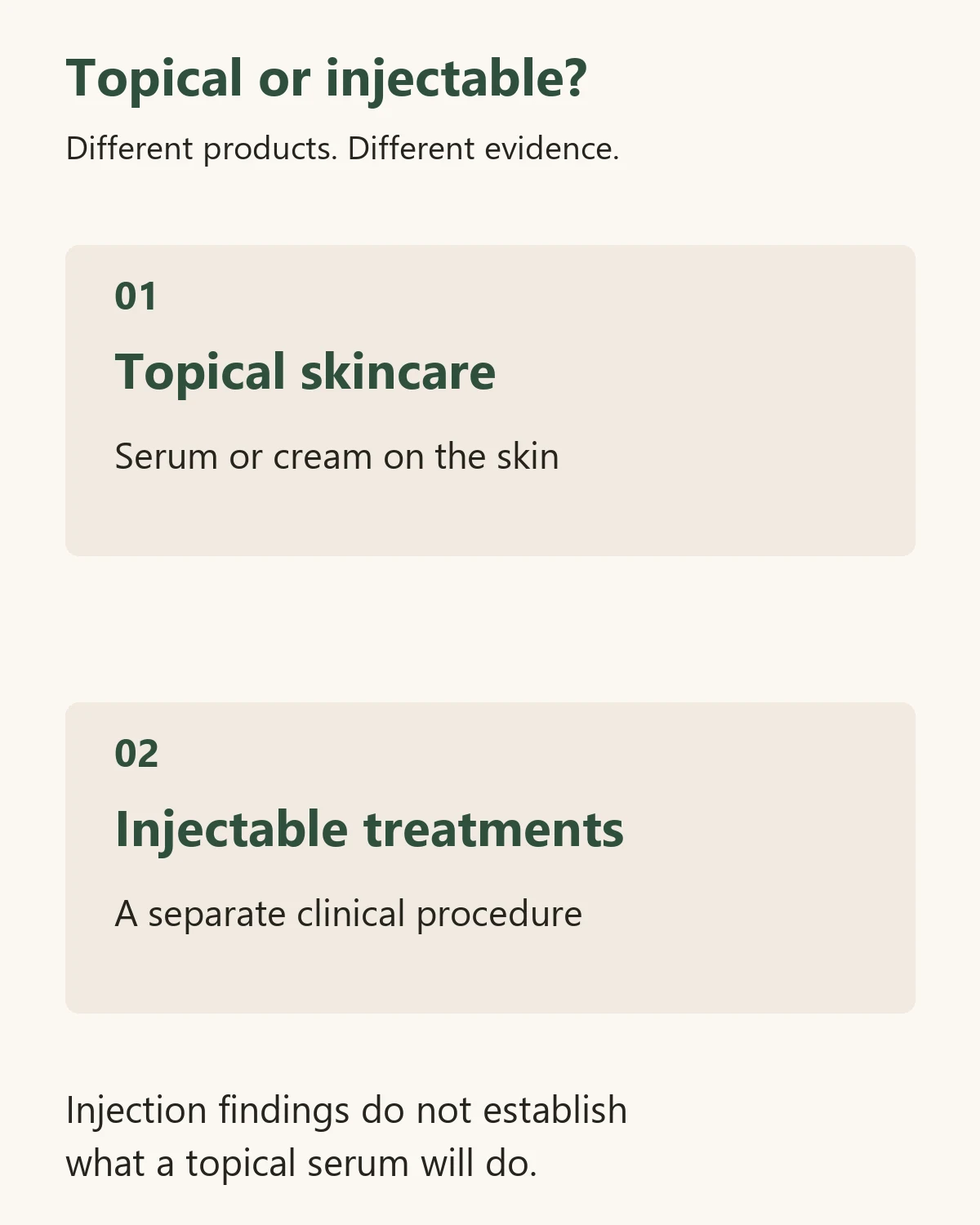
Injections, procedures and products applied to the skin involve different delivery conditions. Evidence from one can't simply be assigned to another. Even a 2026 review of seven randomised trials covered mixed rejuvenation, scar and wound-healing questions. Its 183 participants weren't one large trial of a cosmetic serum.
Korea's enthusiasm is more than a vague social-media impression. Olive Young reported 695% more online PDRN searches during its August–September 2025 sale than the previous September sale, alongside interest in ‘slow ageing’. Korea also has an established clinic culture around injectable polynucleotides: a 2024 survey found PN was widely used among 235 Korean dermatologists familiar with skin boosters. PN injections and PDRN cosmetics are different products. My interpretation is that the clinic association helps explain the cosmetic ingredient's appeal, while the retailer data shows actual shopping curiosity. Neither tells us how well your serum works.
What the new eye-cream trial tested
The PLOS One paper published on 10 July 2026 included a randomised, double-blind, split-face study. Each participant used one treatment on each side of the face, allowing comparison within the same person.
| Detail | What was actually tested |
|---|---|
| Participants | 31 Chinese women aged 35–55 with sensitive skin assessed using the study's screening scale. |
| Formulas | A 0.1% PDRN-850K eye cream and a 0.1% retinol eye cream with the same base formulation. |
| Routine | Twice daily for 28 days; daytime sunscreen was required. |
| Area and measurements | The eye area, with wrinkle imaging and measurements including ultrasound and skin elasticity. |
The authors reported greater short-term improvements on the PDRN side for several measures. The paper also included laboratory and skin-model work supporting a possible biological effect. That's more informative than borrowing an injection's before-and-after photograph to sell a serum.
It is still one defined preparation in one eye-cream formula, tested in a small, specific group. A different PDRN ingredient in a different serum wasn't automatically included in that result.
The important caveat is inside the paper
The authors acknowledge that 28 days is short for substantial mature dermal remodelling. They say early ultrasound changes may partly reflect temporary hydration or plumping, and that longer studies are needed to separate those changes from sustained remodelling.
They also argue that moisturising alone is unlikely to explain all the findings, pointing to the matched base and their laboratory results. Both parts matter. Calling the result “just hydration” dismisses the evidence too quickly; calling it proven long-term regeneration goes further than the study can support.
The retinol comparison needs the same care. Four weeks at one concentration doesn't decide how PDRN compares with longer-term retinoid use. Equal percentage numbers also don't make two different ingredients equivalent doses.
Can PDRN reach the skin?
This paper investigated delivery rather than simply assuming it. Its evidence included reconstructed skin, pig-skin experiments and a Raman-spectroscopy pilot in one human volunteer.
Those observations support further investigation, but the authors describe limits in tracing the material and point out that delivery depends on the formulation. The single-person pilot isn't proof that every serum penetrates to the same depth or produces the same effect.
My conclusion is that topical PDRN has earned a closer look for cosmetic fine-line care, especially when a brand can connect its product to a relevant cream study. The promising result is short-term improvement with one preparation, not proven long-term regeneration. I would explore that specific evidence before buying; I would not make “PDRN” alone a reason to retire retinol.