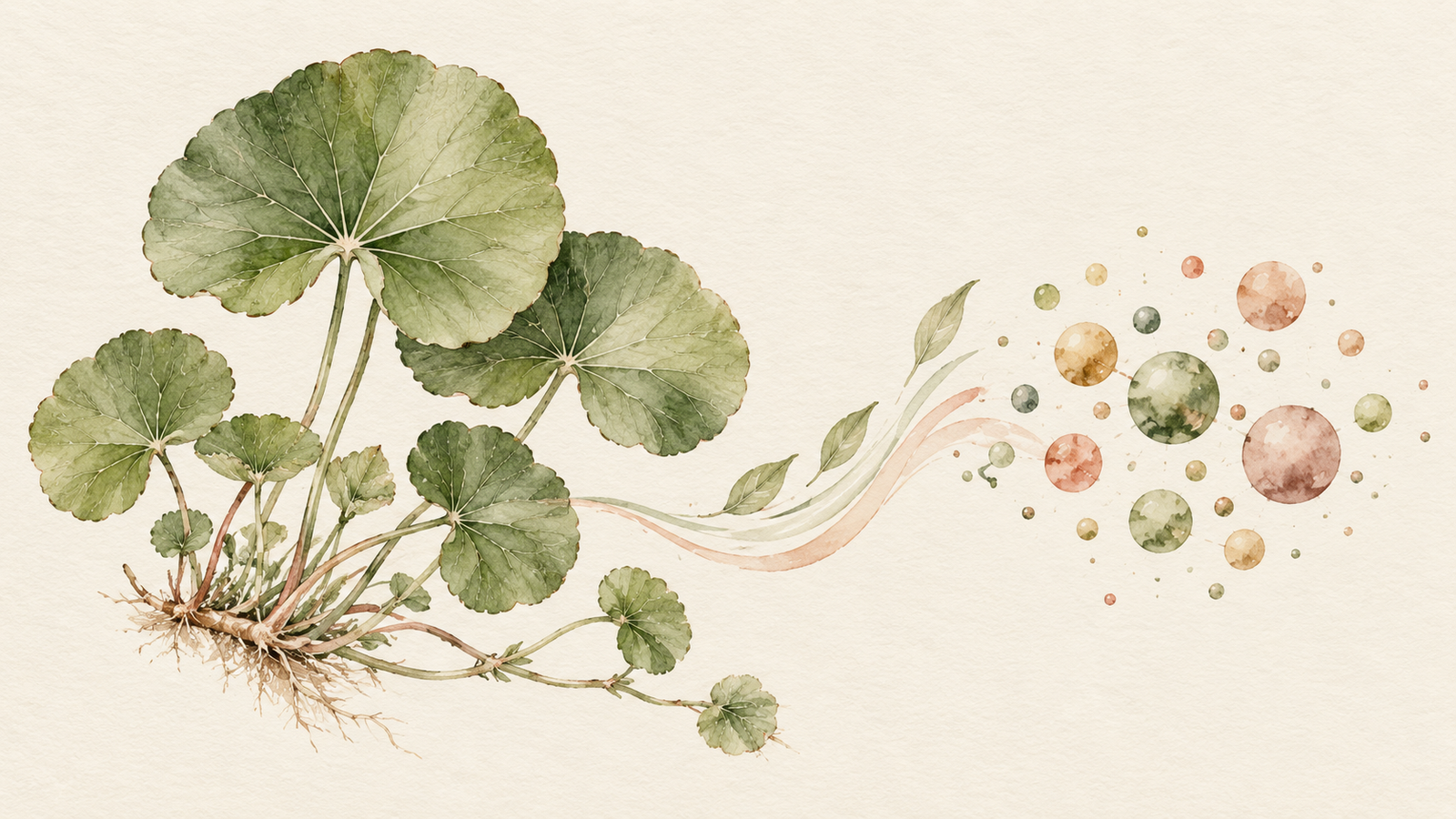
Centella asiatica is a plant. Madecassoside is one of its compounds. Choosing between those names is therefore not quite like choosing between two rival ingredients, and madecassoside is not automatically an upgraded version of centella skincare.
The distinction becomes useful when it explains an actual formula. A botanical extract can contain a mixture of constituents; a separately listed Madecassoside ingredient identifies a particular compound. Neither name, by itself, tells you which finished product will feel more soothing.
One plant, several compounds
“Cica” is a familiar shorthand on Korean skincare packaging, rather than a precise ingredient specification. Centella Asiatica Extract is a more informative label. Madecassoside is more specific again, but specificity and strength are different things.
Centella asiatica is a plant used in skincare aimed at calming uncomfortable-feeling skin. Madecassoside is one of its components, used in soothing and barrier-focused formulas. The everyday reason to try a centella product is skin comfort, not to expect a wound-healing treatment from an ampoule. Niacinamide has a different role, including tone and moisture-barrier support; panthenol adds moisturisation. A centella label does not mean those supporting ingredients are irrelevant.
A dermatology overview of centella names madecassoside alongside asiaticoside, asiatic acid and madecassic acid among the plant’s triterpenes. A centella extract does not disclose the amount of each constituent simply by naming the plant. Equally, a formula without Madecassoside listed separately may still contain that compound within its extract.
The ingredient list tells you what is declared, not a complete chemical analysis of every botanical material.
Two Korean products make the distinction clearer
SKIN1004 is a Korean skincare brand with a centella-focused range. Numbuzin is another Korean brand, organised around numbered product lines. Their published formulas show why “centella versus madecassoside” is an incomplete shopping comparison.
| Checked product information | Relevant detail | What you can conclude |
|---|---|---|
| SKIN1004 Madagascar Centella Ampoule | Water, glycerin, butylene glycol and Centella Asiatica Extract appear in a seven-ingredient list | This is a centella-extract formula. No separate madecassoside dose is stated in that list. |
| Numbuzin No.5 Vitamin Boosting Essential Toner | Madecassoside is separately listed alongside niacinamide, panthenol and other ingredients | The toner includes the named compound, but it is also a broader formula with a tone-care positioning. |
For a watery centella-focused hydration step, I would shortlist SKIN1004. For a toner that combines madecassoside with niacinamide and a tone-care aim, I would shortlist No.5. The current SKIN1004 list contains seven ingredients, so I would judge that actual formula rather than an older “100% centella” description. A shorter list can help identify what you are adding; it does not guarantee tolerance.
The number needs a named material
A high centella-extract percentage does not translate into the same percentage of madecassoside. An extract and a specific constituent are different measurements.
Numbuzin offers a revealing example. Its toner description gives 20,000 ppm for MADEWHITE, while separately listing Madecassoside in the formula. The MADEWHITE figure belongs to the named material described by the brand; it does not establish that the toner contains 2% pure madecassoside.
Which would I choose for an everyday routine?
I would start with the centella ampoule when the aim was a light, focused hydration-and-comfort step. For a toner combining skin comfort with niacinamide-led tone care, the No.5 formula is the more relevant choice. A separate madecassoside entry is useful detail, but the product’s purpose and other ingredients explain the choice.
Madecassoside is studied for effects relevant to skin comfort and repair, which helps explain its place in soothing skincare. That does not turn a daily toner into a treatment for a damaged wound or persistent inflammation. For ordinary skincare, I would judge whether the formula meets the comfort and hydration need that brought me to cica in the first place.
If every product is stinging, switching between two centella labels is not the most useful first move. Look at the cleansing and active ingredients in the whole routine; our skin barrier guide helps with that wider problem.
These are affiliate links. I may earn a commission if you buy through them, at no extra cost to you.
The examples are SKIN1004 Madagascar Centella Ampoule 100 ml and the Numbuzin No.5 toner 200 ml + 200 ml refill set. The latter is a toner, not the No.5 serum.
Centella names the plant; madecassoside names one compound from it. My preference is the focused ampoule for a light comfort step, or the No.5 toner when tone care is part of the aim. The more specific ingredient name is not an automatic reason to buy the more complicated formula.