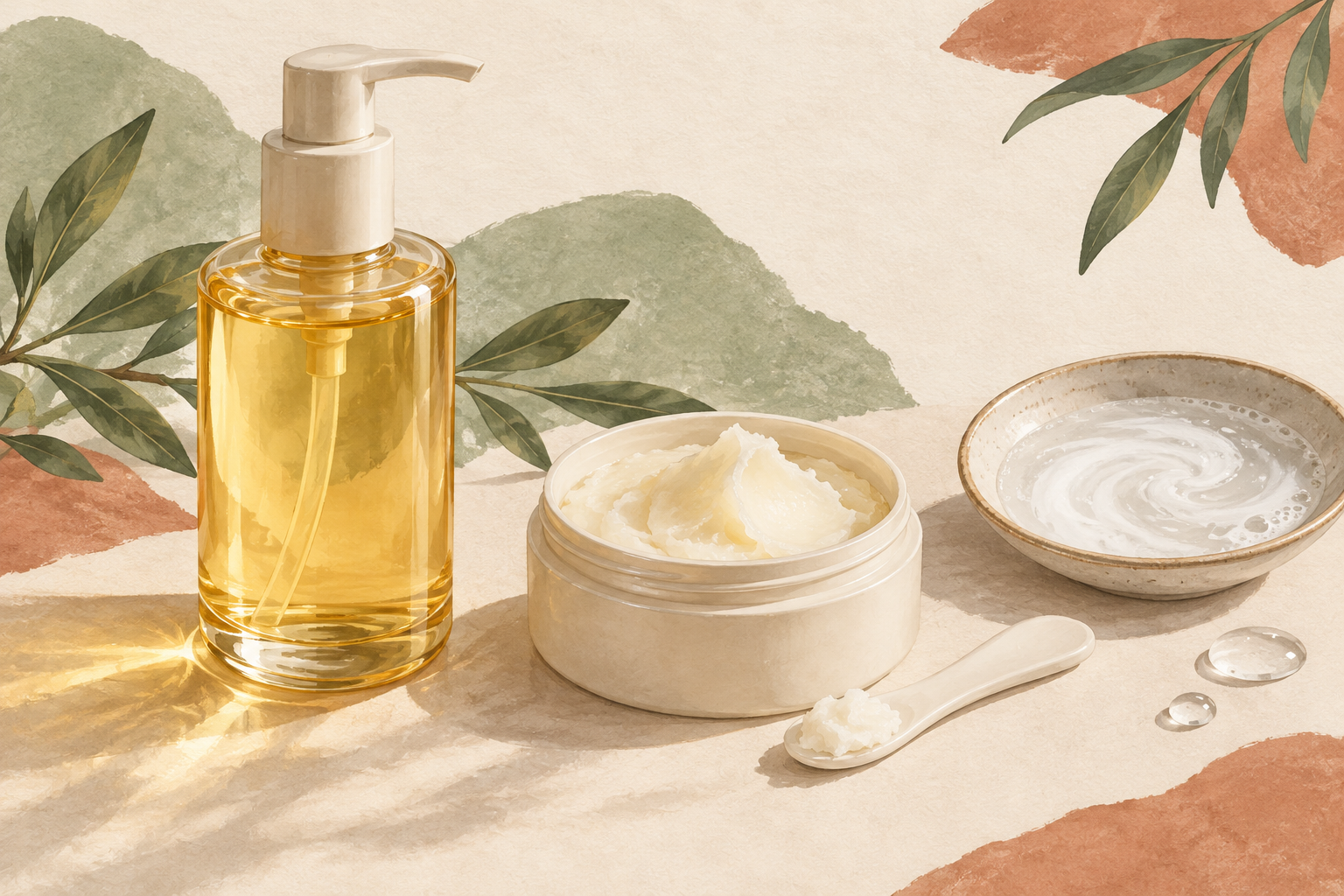
For a quick evening cleanse, I would start with a pump cleansing oil. If you prefer something you can scoop and spread without a liquid running through your fingers, a balm makes more sense. Both are oil-based cleansers; the solid format does not automatically make a balm gentler or better at removing makeup.
The useful comparison is what happens at your sink: dispensing, spreading, adding water and rinsing. Pick the format that makes those steps easy, then choose the particular formula for your skin. You do not need to own both.
The same job, a different starting texture
These cleansers help loosen makeup and oily residue before you rinse. An oil is already liquid. A balm starts as a soft solid and spreads into an oily texture as you massage it. That little transformation can be satisfying, but it is part of using the cleanser, not evidence that it is doing a deeper clean.
The formula also contains ingredients that help the oily mixture disperse when water is added. This is emulsification: the cleanser often becomes milky, making it easier to rinse away. Simply splashing water onto an oily face and immediately washing it off can miss that mixing step.
This is why switching from an oil to a balm will not necessarily solve a rinsing problem. The new texture still needs to meet water. If you use ma:nyo, our Pure Cleansing Oil guide explains that step in more detail.
Choose oil when dispensing speed matters
A pump is a good fit when you want to get on with removing the day's makeup. You can dispense the recommended amount straight into your palm, spread it over dry skin and start massaging. There is no lid to unscrew or spatula to put away afterwards.
The practical compromise is that liquid flows. Dispense it into a cupped hand rather than pumping it onto your fingertips, especially if you tend to lose some down your wrist. If that is your main annoyance with cleansing oil, a solid balm offers a straightforward alternative without changing the purpose of the step.
I would choose a pump for a regular bathroom routine where the bottle stays beside the sink. For travel, the closure matters more than the word oil: a pump with a proper lock or a secure cap is more useful than an attractive bottle that opens easily in your bag.
Choose balm when you prefer a scoop
A jar lets you take a portion of solid product before it melts. That suits someone who likes spreading the cleanser in stages rather than managing a palmful of liquid. A small spatula also helps you lift out a portion without putting wet fingers into the remaining balm.
There is a little extra handling: open the jar, scoop, close it and clean the tool. That is a reasonable trade for the texture if you enjoy it. If you already find evening cleansing a chore, buying a balm for its elaborate skincare ritual is unlikely to make the chore shorter.
A solid starting texture can be convenient to pack, but it does not guarantee a leak-proof container. Secure the lid and follow the product's storage instructions. A secure container matters more than whether the cleanser starts as a solid or a liquid.
Balm for dry skin, oil for oily skin? Too tidy
That rule sounds helpful until you look at real formulas. Both formats contain oily cleansing ingredients, and balms need ingredients that hold their solid texture. The whole combination determines the cleanser you are using, not just the noun on the front.
Beauty of Joseon, a Korean brand known for skincare inspired by traditional botanical ingredients, provides a useful example. Its Radiance Cleansing Balm ingredient list includes oil-like ingredients and synthetic wax. Its Ginseng Cleansing Oil formula starts with soybean oil. The balm is not simply the oil made thicker.
For easily irritated skin, I would narrow the choice to gentle, fragrance-free options before deciding between pump and jar. For skin that feels tight after washing, look at the entire cleanse, including your second cleanser and how much rubbing you do. A richer starting texture cannot rescue an unnecessarily harsh routine.
Make the water step count
Start with dry hands and a dry face when the product directs you to. Gently spread the cleanser so it can work through the makeup; a balm needs a moment to soften. Add a little water, massage the mixture, then rinse thoroughly with lukewarm water. Beauty of Joseon's directions use this sequence for both formats.
Follow with a gentle water-based cleanser if that is the product's intended routine. You do not need to scrub harder to make the process worthwhile. If a waterproof eye product is proving stubborn, follow its removal instructions rather than turning your whole face cleanse into a long rubbing session.
Is the extra cleanse worth doing?
It is most useful when a single gentle wash leaves you struggling to remove makeup or water-resistant sunscreen. There is a clear job for the first cleanser in that situation. If your usual cleanser already removes what you wear comfortably, adding another product is not automatically an improvement.
Cleveland Clinic's double-cleansing guidance explains that most people do not need to double cleanse and that excessive washing can cause dryness and irritation. A clean, comfortable face is the aim; a squeaky feeling is not a target to chase.
My choice is a pump oil for speed, or a balm if the controlled scoop makes application easier for you. Spend the extra effort on adding water and rinsing properly, not on collecting both textures. The better cleanser is the one that removes what you wear without making the end of the day more complicated.