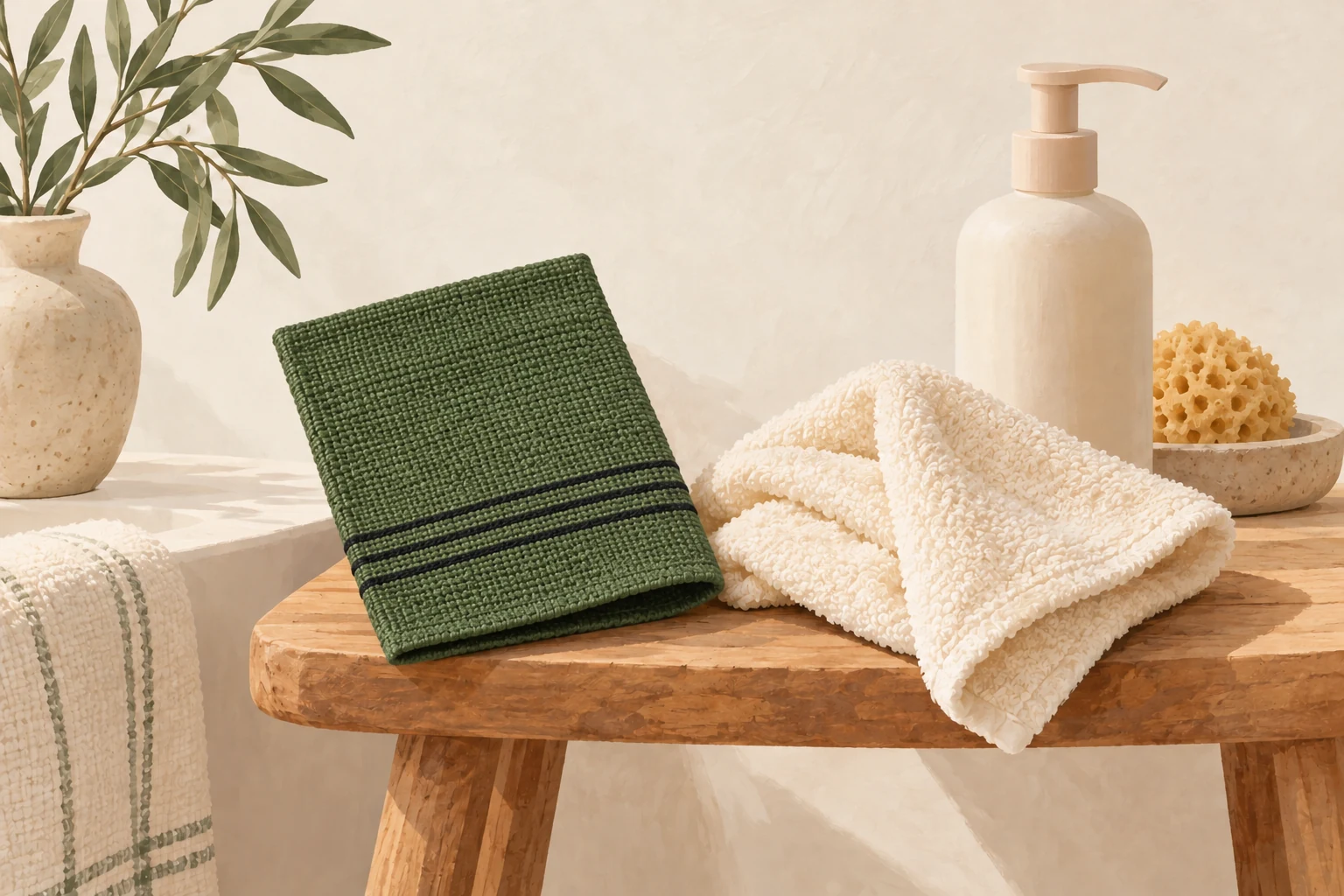
An Italy towel is a textured cloth used for body scrubbing in Korean bathing culture. It is often a small mitt, rather than the soft towel you dry yourself with. Its job is physical exfoliation: rubbing away some surface skin cells.
That can appeal if you enjoy a smoother skin feel. But scrubbing until lots of rolls appear is not a necessary standard of cleanliness. If your skin already feels dry, tight or stings easily, I would choose a gentle wash and moisturiser over a rough mitt.
For me, the familiar green Italy towel is too rough and painful. I also notice softer towels being used with body wash more often. That is a useful distinction: you can enjoy washing with a cloth without wanting an abrasive body scrub. The two tools do not have to do the same job.
A bathhouse tool, rather than a new beauty invention
You may see it sold as an “Italy towel,” a Korean exfoliating mitt or a body scrub towel. Those listings are often pointing to the same general kind of tool, although the actual fabric and roughness can differ.
In Korea, it belongs to the language of body scrubbing and public baths. *Seshin* is the body-scrubbing service associated with that setting; a mitt used at home is not the whole bathhouse experience. The National Folk Museum of Korea's account of bathing culture places Italy towels and scrubbing within a broader social space, with bathing, conversation and relaxation.
Are the little rolls a good target?
A rough cloth can lift material from the skin's surface. What you see coming off is not a measurement of how dirty you were, how healthy your skin is, or how much more you should remove. I would not keep working on the same area simply to produce a bigger pile.
The important detail is that “dead skin” is not all useless skin waiting to be removed. The outer barrier contains dead cells and lipids that help keep water in and protect what lies beneath. Cleveland Clinic's barrier guidance identifies over-scrubbing as one way to damage that protection. Skin that feels tender or stings afterward is giving you a more relevant signal than the amount on the cloth.
This is also a different question from the rolls produced by peeling gels. With a cloth, the action is friction from the textile. With a gel, the formula's own pilling matters too. Neither deserves to become a competition to see how much you can roll away.
If you want to try one, keep the first attempt modest
Use a body mitt as a body tool; I would not transfer a rough scrub cloth to the face. For a first attempt, I would choose one small area of comfortable, unbroken body skin rather than plan a head-to-toe session.
Use lukewarm water, damp skin and a wet cloth. Start with light, short strokes; do not increase pressure just because little is coming off. Rinse and moisturize afterward. Skip wounds and sunburn. These choices follow the American Academy of Dermatology's guidance on gentle exfoliation, which also warns that aggressive exfoliation needs less frequent use.
There is no weekly timetable I would prescribe to everyone. Dry, sensitive or acne-prone skin can find mechanical exfoliation irritating; aggressive methods can also be a poor choice if irritation tends to leave dark marks. A bathhouse story is not a reason to copy a long, very hot soak or push through discomfort at home.
The next-day result matters. If you like the feel and your skin remains comfortable, you can decide whether this occasional step is worth keeping. If it becomes a cycle of scrubbing and then trying to soothe tightness, I would drop the scrub rather than buy a stronger mitt.
A soft washcloth or a scrub mitt?
For everyday washing, I would choose a soft cloth with body wash. It spreads the lather and gives you something comfortable to wash with, without making strong exfoliation the purpose of the shower. If the green mitt hurts, there is no benefit in trying to become accustomed to that pain.
For someone who specifically enjoys occasional body exfoliation, a textured mitt is a separate choice. Pick it for that purpose and use it gently; do not assume that it should replace your everyday washing cloth. A softer-feeling tool can still create friction, so “soft” is not permission to scrub harder.
What would make one worth buying?
I would look for a clear description of the texture, a size that stays comfortably on the hand, and care instructions I can realistically follow. A colour in a product photo is not enough to tell you how abrasive every maker's cloth will be. “Authentic” is a cultural description, not a guarantee that the roughest option suits your skin.
Think about the extra work, too. This is a reusable cloth that needs cleaning and drying according to its care instructions. If you already dislike dealing with wet bathroom accessories, that small chore belongs in the decision. A cheap purchase is not automatically a useful purchase.
If a comfortable wash and body moisturiser already leave your skin feeling good, you have a complete routine. A scrub mitt should earn its place by offering a result you actually enjoy, rather than by making the shower look more authentically Korean.
My verdict
The Italy towel is an interesting, practical part of Korean bathing culture, but the rough green version is not my choice for everyday washing. I would start with a softer cloth and body wash, then consider a separate, gentle exfoliation step only if I wanted one.
If you do enjoy using a scrub mitt, comfortable skin afterward is the result to aim for. The amount that rolls off is not a score to beat. Understanding the Korean tradition should help you choose a routine you like, not persuade you to put up with a cloth that hurts.