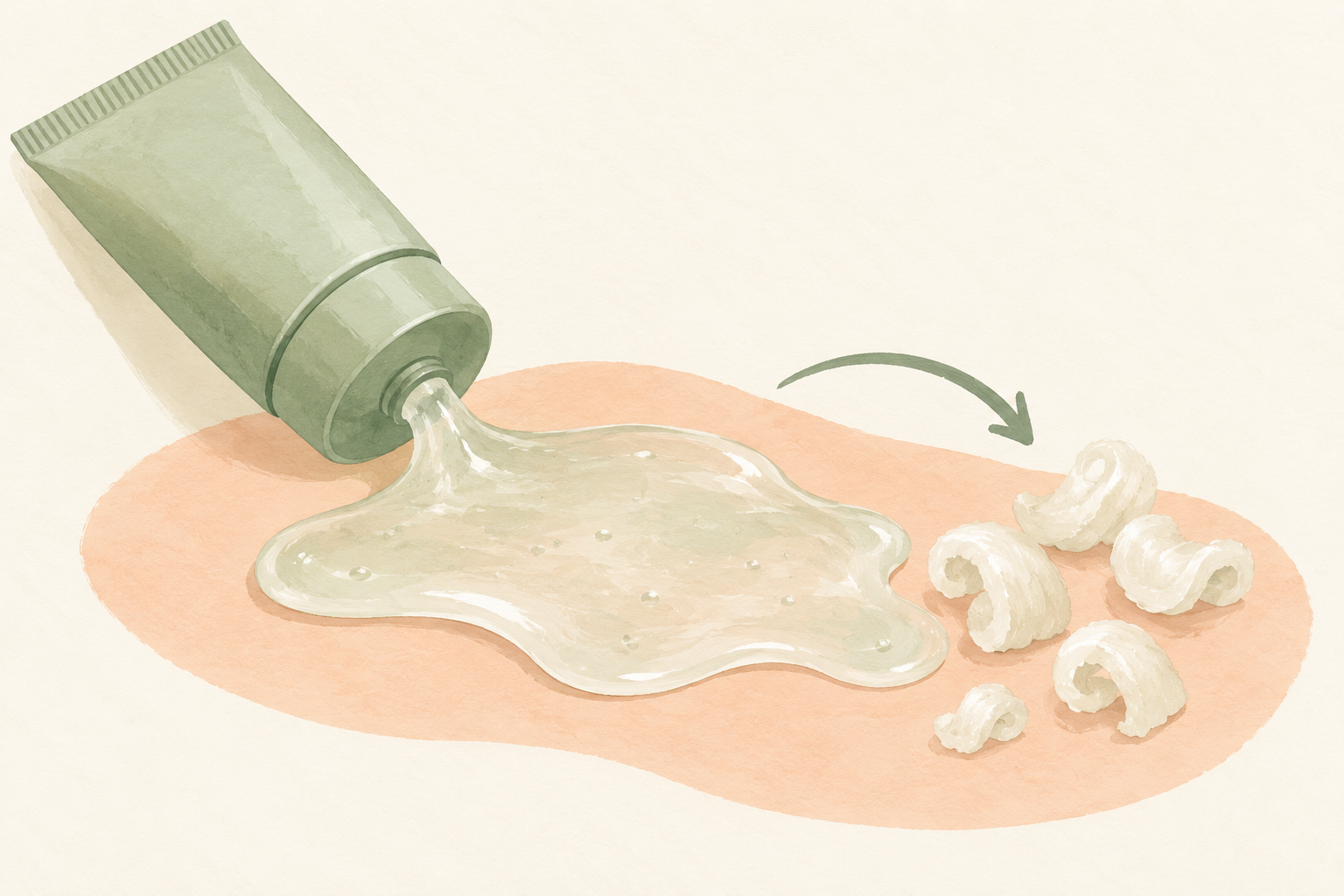
The little rolls that appear when you massage a peeling gel are largely the product itself. They can carry loose surface skin cells with them, but they aren't a visible tally of everything your face needed to shed.
That doesn't make a peeling gel pointless. A rolling, rinse-off gel can help smooth loose surface flakes. The useful question is whether your skin feels smoother and stays comfortable afterwards, rather than how big a pile you can produce.
What cellulose is doing in the gel
Cellulose helps form the soft fibres that gather as you rub. Carbomer, another name you may spot, is a polymer used to give products their gel texture. In rolling formulas, ingredients like these contribute to the clumps; rubbing and skin oils help the process along.
Michelle Wong's peeling-gel demonstration makes the distinction easy to see: adding oil helped gels clump on gloves, without any skin to peel. That's a much better explanation for the impressive rolls than assuming a mountain of dead cells has suddenly detached.
Think of the gel as providing its own soft rubbing material. As you massage and rinse, some loose surface material can come away too. There is no need to dismiss the whole step as a trick, or to believe every bit of residue was once part of your face.
A rolling gel and an acid exfoliant do different jobs
A rolling gel gives you a physical exfoliating step: the massage and gathered product help lift loose material from the surface. An acid exfoliant uses ingredients such as AHAs, including lactic acid, or BHAs, including salicylic acid, to help remove dead surface cells chemically. You don't need a pile of rolls for that process to count as exfoliation.
This matters when choosing the format. If you enjoy a brief massage followed by rinsing, a rolling gel offers that experience. If you prefer an exfoliating step without rubbing, an appropriately formulated chemical exfoliant may suit the routine better. Neither format automatically wins for every skin type.
Some formulas are designed to combine rolling with acids or enzymes. So I would treat the physical action and any added exfoliating ingredients as parts of the same step, rather than assume that a gel is just moisturising skincare with an entertaining finish.
This confusion exists in Korea too
A 2025 Korean report explained the same misunderstanding through interviews with a beauty academic and skincare companies. The amount of rolling can change with friction, moisture and oil, so more rolls do not neatly mean more dead skin.
I think this is the part that deserves more attention when Korean peeling gels travel abroad. The product gives you something very visible to look at, while the useful result is much less theatrical: a surface that feels a little smoother. The residue is an easy selling point because you can see it immediately. It is a poor scorecard for your skincare.
Similar rolls can mean something else in your routine
There is an important difference between a peeling gel rolling during its instructed massage and sunscreen balling up when you apply foundation. The first is part of how a rinse-off product is intended to behave. The second is a problem with the layers you want to leave on your face.
I wouldn't respond to sunscreen pilling by immediately adding a stronger exfoliating step. First look at when the rolling starts and which optional layers are underneath. Our sunscreen pilling guide explains that sequence. A similar-looking crumb doesn't mean the same thing in every routine.
Where I would use one, and where I would skip it
For occasional roughness on otherwise comfortable skin, a rinse-off rolling gel is a reasonable option to consider. Its appeal is a quick surface polish, without leaving another exfoliating layer on your face. I would keep it as an occasional step, rather than a daily target.
If your skin is flaky and stings when you apply moisturiser, I'd prioritise gentle cleansing and moisturising instead of more rubbing. Dryness isn't an instruction to scrub. Our guide to skincare that stings looks at that situation in more detail.
For clogged pores, I wouldn't choose a gel because it produces satisfying rolls. Salicylic acid, a common BHA ingredient, is used to help unclog pores; that is a different job from polishing loose flakes on the surface. The American Academy of Dermatology's pore guidance explains that option without promising that every blemish needs an exfoliant.
How I would fit it into a routine
Keep the occasion simple: cleansing, the gel as directed, then moisturising. Follow the instructions for whether your skin should be wet or dry. Manufacturer instructions I checked ranged from a short 20-second massage to up to a minute. Those are directions for different formulas, rather than a reason to keep rubbing whichever one you own for longer. I would set the product's instructed limit before starting.
If an acid toner or exfoliating pad already handles the roughness you're concerned about, a rolling gel isn't automatically the missing step. I would decide whether to try a different format instead of adding both to the same session just because their textures look different. That makes it easier to judge whether the gel actually adds something useful.
After rinsing, the result I'd look for is comfortable, smoother-feeling skin. A face that looks polished but feels sore is a reason to stop using it, rather than an achievement to maintain. If the same rough patch keeps returning with redness or discomfort, I'd seek advice on the cause instead of responding with longer massages.
Use the gel, then stop chasing the rolls
Use light pressure and moisturise afterwards. If you're already using retinol or benzoyl peroxide, adding exfoliation can increase irritation. The AAD's exfoliation advice also makes clear that frequency depends on the person and method, rather than a universal weekly number.
My verdict: a peeling gel earns its place if it makes a rough surface feel smoother without leaving it sore or tight. It doesn't earn extra points for producing more waste. Once you've used and rinsed it as directed, leave your skin alone; there is no prize for rubbing until nothing rolls off.