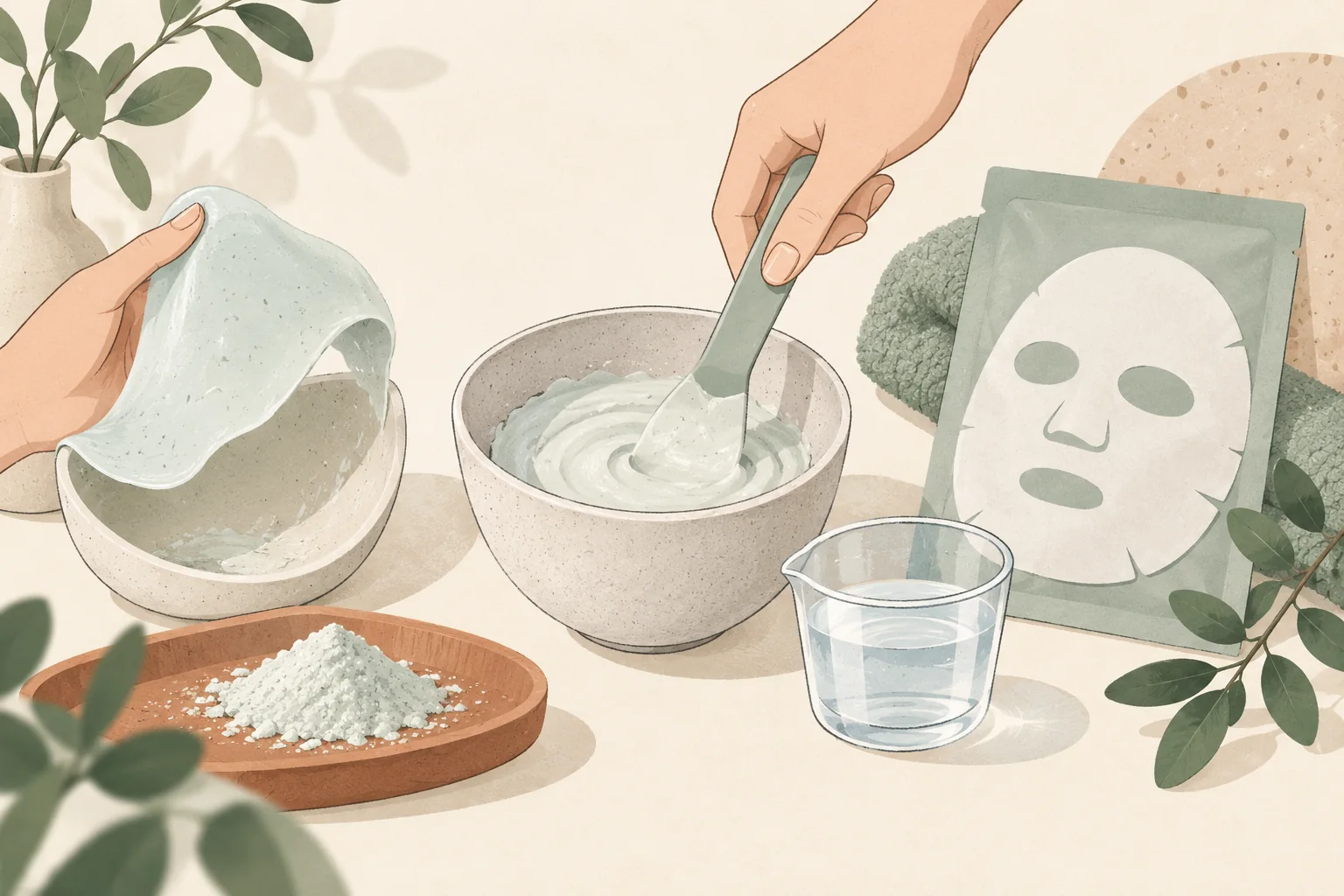
A modelling mask starts as powder, mixes into a paste and sets on your face as a flexible gel covering. You then lift it away. It is also called a rubber mask, which describes the texture rather better than the word “modelling”.
For a first try, I recommend a single-use cup rather than bulk powder. A modelling mask suits an evening when you want to take time over your skincare. A ready-made sheet mask is easier if you would rather skip the mixing and washing-up.
What turns the powder into a rubbery mask?
The useful ingredient to recognise is alginate, a material derived from brown algae. It can form a gel network with calcium, holding water within that structure. This is why a mixed paste can become a flexible covering instead of simply remaining a wet powder.
You are watching the mask set. A smooth piece coming off your face tells you that the material has held together; it does not tell you how much an ingredient has entered your skin. Choose the format for the gel covering and the skin feel you want afterwards, rather than treating a neat peel as a skincare result in itself.
I am familiar with the mixed-mask part of a facial from visits to skin clinics in Korea. I have had masks prepared and applied for me there several times. As the person lying back, I never had to think about measuring, mixing or cleaning the tools.
At home, you have to measure the water, mix and apply the mask, then clean up afterwards. That is the extra work to weigh against the pleasure of taking time for a mask.
Lindsay is a Korean skincare brand that sells modelling-mask powder in single-use cups and larger bags. The cup format is a useful starting point for seeing how much preparation you want to do at home.
Start with a cup, not a cupboard full of equipment
Lindsay's official catalogue shows a 28g single-use cup with a spatula that also measures the water. You mix in the cup, so a separate bowl is unnecessary for that format. That removes two small obstacles to trying it: deciding how much powder to use and finding a suitable mixing container.
Keep the supplied measure with the pack. A scoop count makes sense only with the scoop it refers to. A kitchen tablespoon, another brand's measuring cup and the small end of a spatula can hold different amounts. Copying a number from a tutorial while changing the tool is an easy way to change the mixture as well.
Bulk powder makes more sense once you know you like the process. You need somewhere to mix it, a way to measure consistently and somewhere to keep the remaining powder dry. I would finish a cup before buying a large bag, even if the bag looks better value. Unused powder is a poor saving.
The preparation matters more than a perfect spreading technique
Have the water, spatula, mirror and something to keep your hair back ready before mixing. Once the powder and water meet, the setting process gives you a reason to work promptly. Hunting for a hairband halfway through is an avoidable extra step.
Use the amount of water and the mixing instructions on your particular pack. Mix until the paste is even, then spread it over the intended areas with the spatula. Aim for an even, substantial covering rather than a fine coating with wispy edges. Very thin edges are more awkward to lift cleanly.
For home use, keep the mixture away from the eyes, nostrils, lips and hairline. There is no need to copy videos that cover someone's entire face. A manageable application is more useful than a dramatic one, especially when you are applying it yourself.
Leave it for the wear period specified on the pack, then gently lift away the set mask. Soften and wipe away small remaining bits rather than tugging at your skin. Finish with your usual moisturiser if your skin needs it. You do not need to add several ampoules and serums underneath to use the mask.
What benefit makes the effort worthwhile?
Lindsay describes its Cool Tea Tree version as cooling and soothing. If you enjoy resting with a cool gel mask on your skin, that may be a reason to try this format. The mixing and cleanup are the extra steps to consider.
I would choose a modelling mask when I have time and feel like making an evening of it. For a quick mask before bed, I would reach for a sheet mask.
A preformed hydrogel is another option if you like a gel texture but do not want to mix powder. Our Biodance mask guide explains that format and its much longer suggested wear. Gel masks can look similar in a shopping photo while asking for very different amounts of your evening.
If your main problem is skin that stays dry between masks, put attention into a moisturiser you can use consistently. An occasional mask can be enjoyable without becoming the foundation of daily moisture care.
Include the washing-up in your decision
The session ends with a used mask, a spatula and possibly a bowl. Collect the solid mask and residue for the bin, then clean the reusable tools. The small pieces around the face and the leftover mixture are part of the work, even when the application went well.
This is why a single cup is my first choice for someone curious about the format. It lets you decide whether you enjoy mixing, spreading and removing it before committing to repeated preparation. If those steps sound satisfying, a modelling mask has a clear place as an occasional beauty ritual. If you would rather open a packet and relax, take the sheet mask. Convenience is a good reason to choose it.
Try a single cup
These are affiliate links. I may earn a commission if you buy through them, at no extra cost to you.
Find Lindsay Modeling Mask Cup Pack 28g on Olive Young Global. This listing offers the single-use cup format with a choice of types, rather than the 1kg bag.