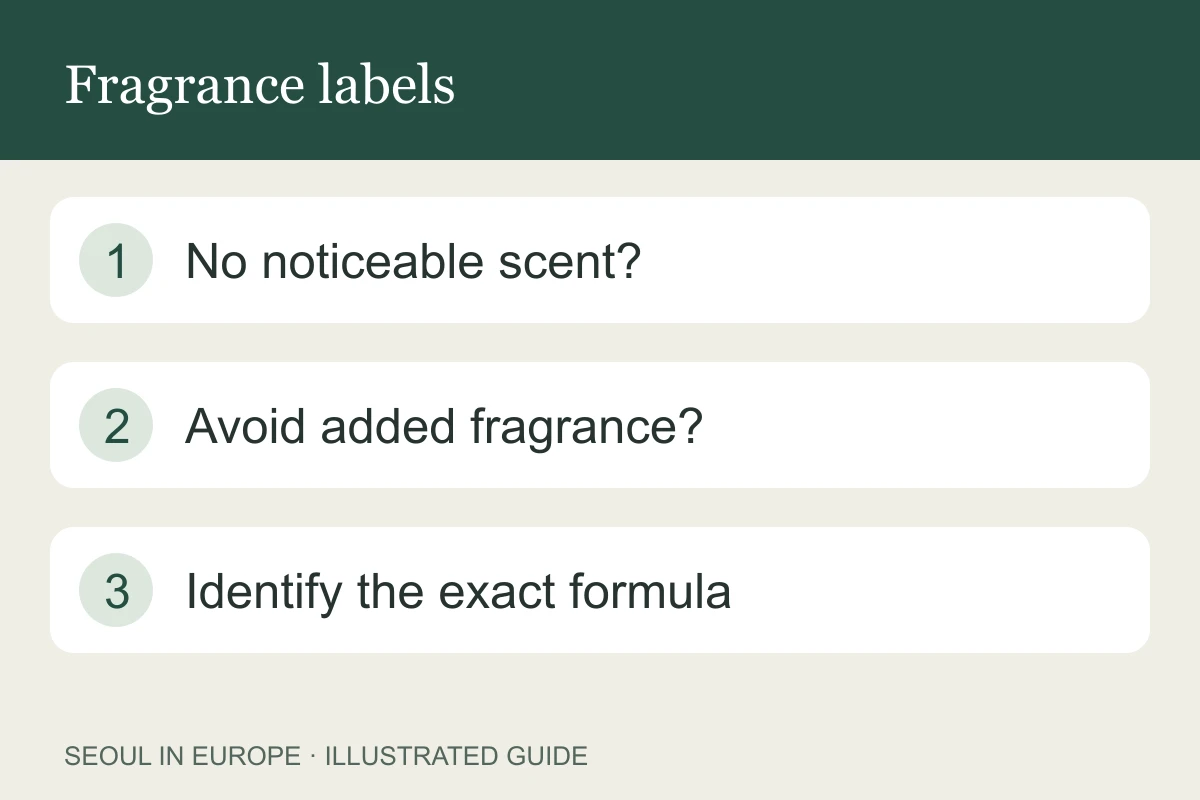
A product that smells of nothing is not necessarily free of fragrance ingredients. “Unscented” can describe a formula whose other smells have been masked. “Fragrance-free” is a useful shopping clue for someone trying to avoid added fragrance, but your nose alone cannot establish what is in a bottle.
To me, checking fragrance feels like an ordinary part of choosing face skincare in Korea, alongside looking at other ingredients. Once it becomes a shopping filter, the distinction matters: avoiding a perfume-like smell and avoiding added fragrance are not necessarily the same decision.
When shopping online, compare the exact product's ingredient information with its description. A short translated phrase such as 'no scent' can leave the ingredient question unanswered.
No noticeable scent is a different claim
The FDA's fragrance explanation notes that some unscented products contain fragrance ingredients added to mask other smells without creating a noticeable scent. That explains how a formula with no noticeable scent can still include fragrance.
Some unscented formulas may be fragrance-free, while others use masking ingredients. For a particular purchase, look beyond the translated label to the formula or ask the manufacturer what its wording means.
You may also notice a raw-material smell in a product not designed to perfume the skin. That is not, by itself, proof that the brand secretly added perfume. An ingredient list and a manufacturer's clarification can answer a question that a sniff cannot.
Why “natural” does not solve it
Botanical oils and extracts can be included for several reasons. A plant name on the front does not establish that the complete formula is suitable for fragrance-sensitive skin. Equally, a long unfamiliar ingredient name is not evidence that it is a perfume ingredient.
If you already know a particular ingredient causes trouble for you, keep that specific information in view instead of relying only on broad words such as clean, gentle or natural. A diagnosed allergy needs more precise advice than a general shopping comparison can provide.
Our guide to moisturiser stinging addresses the separate question of discomfort. A sting does not automatically diagnose a fragrance allergy or an impaired barrier.
Make fragrance a useful filter
The American Academy of Dermatology recommends gentle, fragrance-free products for dry skin and warns that unscented products can contain odour-masking ingredients. That gives a practical starting point without promising that any one label guarantees tolerance.
I would use fragrance-free to narrow the shortlist when avoiding fragrance was the goal, then consider the whole product and its purpose. A comfortable moisturiser does not need replacing simply because another brand advertises a more ambitious list of exclusions.
For an unfamiliar product, introduce it with the rest of the routine familiar enough to judge. A quieter scent may be more pleasant, but that is a sensory preference, distinct from knowing which ingredients your skin tolerates.
The question to take shopping
Instead of asking only “Can I smell this?”, ask “Am I trying to avoid a noticeable scent, added perfume or a particular ingredient?” Those are related but different goals.
Someone who dislikes perfume in a face cream may be satisfied with a product that feels and smells comfortable. Someone with a known fragrance allergy needs a more specific check. Keep the label as a clue, the ingredient information as evidence and your actual tolerance as part of the decision. None of them is fully replaced by the word “unscented”.