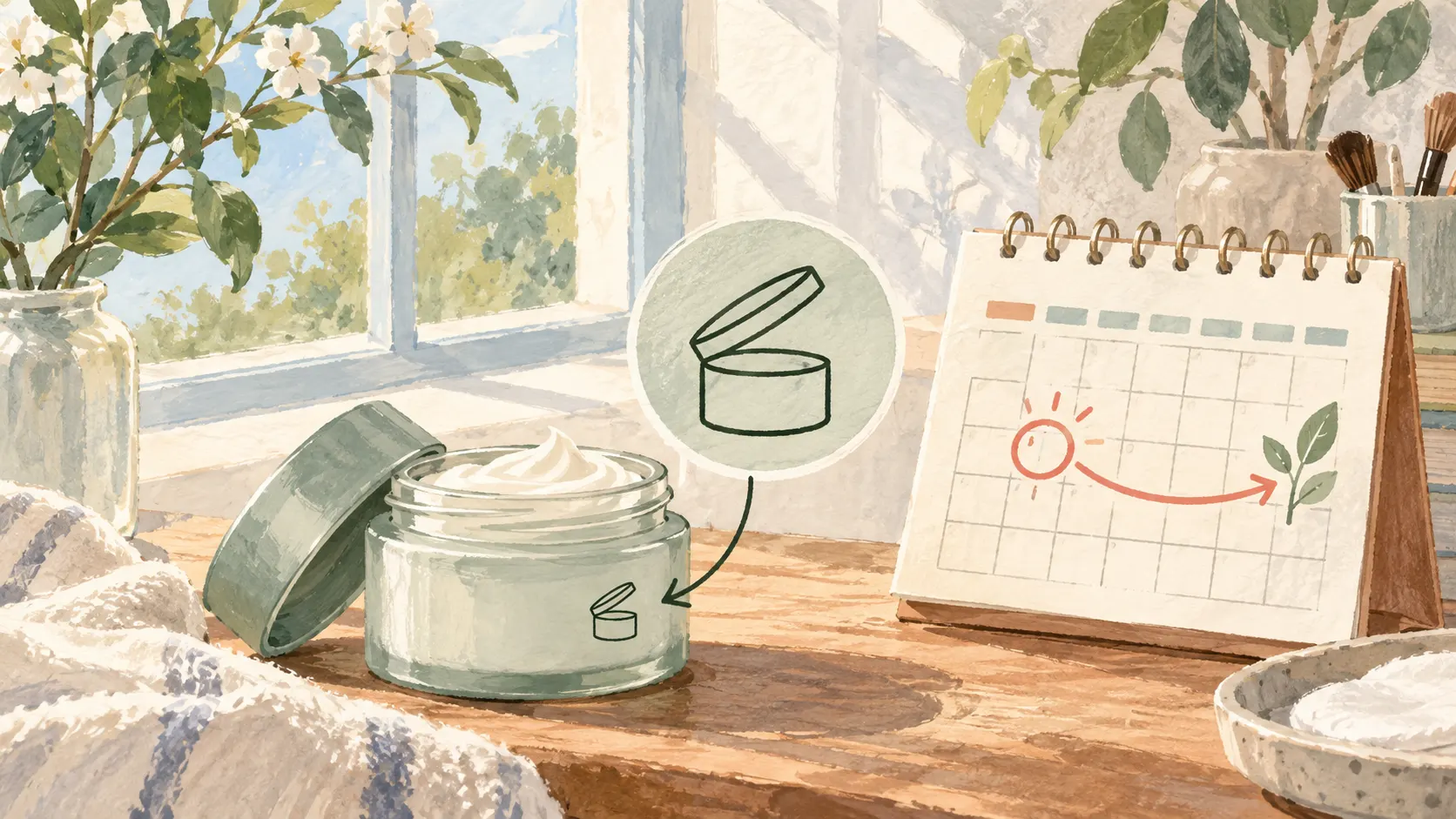
A date on a Korean skincare bottle can mean when it was made or when it should be used by. 제조 or 제조일자 indicates manufacture; 사용기한 indicates the use-by period. The small open-jar symbol tells you something different: how long to use the product after opening.
Identify the marking before doing any arithmetic. When both a printed expiry date and an opening period apply, follow the earlier limit. Twelve months after opening doesn't mean twelve months after manufacture or delivery.
Where is the date hiding?
Finding the marking can be more awkward than reading it. On packs I've checked, it has appeared on the outer cardboard box, the base of the container, near the top or on the label. It isn't always beside the ingredient list.
Before throwing away the box, check these places:
- The outer carton, including its base and end flaps.
- The bottle or jar base.
- The top of the container or the sealed end of a tube.
- The label, including any instruction directing you to another part of the pack.
If the date is on the box, keep that information with the product: a quick photo or a note is enough. Then check the words beside the date before deciding what it means.
The Korean words to look for
You don't need to read the entire label. Matching the words beside the date is often enough to understand what that number is doing.
| Marking on the pack | Meaning in English | How to use it |
|---|---|---|
| 제조 / 제조일자 / 제조연월일 | Made / date of manufacture | Tells you when the product was made; not its expiry date |
| 사용기한 | Use-by period or expiry information | Look for the stated date or accompanying instruction |
| 까지 | Until | A date followed by this word means “until”; read its surrounding label |
| 개봉 후 | After opening | Start counting when you open the product |
| 제조번호 | Manufacturing batch number | Identifies a batch; don't treat it as a date |
These are the actual Korean characters you may need to recognise. Imported packs may instead use MFG, EXP or an English explanation. A nearby batch number isn't a substitute for expiry information.
Korea's Cosmetics Act requires use-by or period-after-opening information, with a manufacturing date alongside the latter. That explains why a manufacturing date can legitimately appear on a Korean pack. It doesn't give everything made in Korea one universal shelf life.
Read a full marking, not just the digits
The examples below are invented to demonstrate the format, rather than markings taken from a particular product.
| Hypothetical marking | What it tells you |
|---|---|
| 2026.04.30 제조 | Made on 30 April 2026 |
| 사용기한 2028.04.30까지 | Use by 30 April 2028 |
| MFG 2026.04.30 | Manufacturing date: 30 April 2026 |
| EXP 2028.04.30 | Expiry date: 30 April 2028 |
| 개봉 후 6개월 or an open jar marked 6M | Use within six months after opening |
| LOT A26104 | A batch code, not a date you can reliably decode on your own |
In these full-year examples, the order is year, month, day. Don't rearrange an ambiguous abbreviated code until it looks like a plausible date. Ask the manufacturer what that particular marking means.
A manufacturing date also doesn't justify adding an assumed three years. If the product gives a shelf-life instruction, use that instruction; otherwise establish the expiry information rather than borrow a rule from another serum.
When the printed date and open jar meet
PAO means period after opening. In the open-jar symbol, M stands for months: 6M means six months and 12M means twelve months.
Imagine opening a bottle on 1 October 2026 with a 6M opening period:
- If the expiry date is 31 December 2026, that printed date comes first. Finish using it by 31 December, rather than carrying it into April.
- If the expiry date is 30 April 2028, the opening period comes first. Six months from opening takes you to 1 April 2027.
Opening the bottle hasn't bought it extra time beyond expiry. A distant expiry date hasn't cancelled its opening period either.
EU-labelled cosmetics may not show both markings. For products lasting thirty months or less, the date of minimum durability is the relevant labelling requirement. For longer-lasting products, PAO information is used where appropriate. Ireland's regulator HPRA explains the distinction. An imported bottle without an EXP date isn't automatically missing its required shelf-life information if it has the applicable PAO marking.
A small note beats a heroic memory
I usually finish my skincare within a few months of buying it, so date-checking hasn't been a constant concern for me. For an everyday product, a useful approach is to check the stated limits when you open it and note the opening date on the bottle or in your phone. If both limits apply, record the earlier one at the same time. “Opened 1 October; finish by 31 December” is more useful than trying to remember when the parcel arrived.
Keep an unopened refill's date separate from the bottle already in use. Our refill-set guide explains when a backup is a useful purchase. Its opening countdown doesn't start merely because you opened the main bottle.
Storage still matters. Follow the pack's instructions, close the lid and avoid contaminating the contents. A change in smell, colour or consistency is a reason to stop sooner; looking normal isn't proof that a product remains suitable after its stated limit.
Be particularly careful with sunscreen. The American Academy of Dermatology advises discarding expired sunscreen, and excessive heat can damage it before expiry. Sun protection isn't something to judge by whether an old tube still looks all right.
The useful habit is simple: identify what the printed date means, note when you open the product and use the limit that actually applies. Once you can recognise 제조, 사용기한 and the open jar, the Korean label becomes a practical instruction rather than a guessing game.