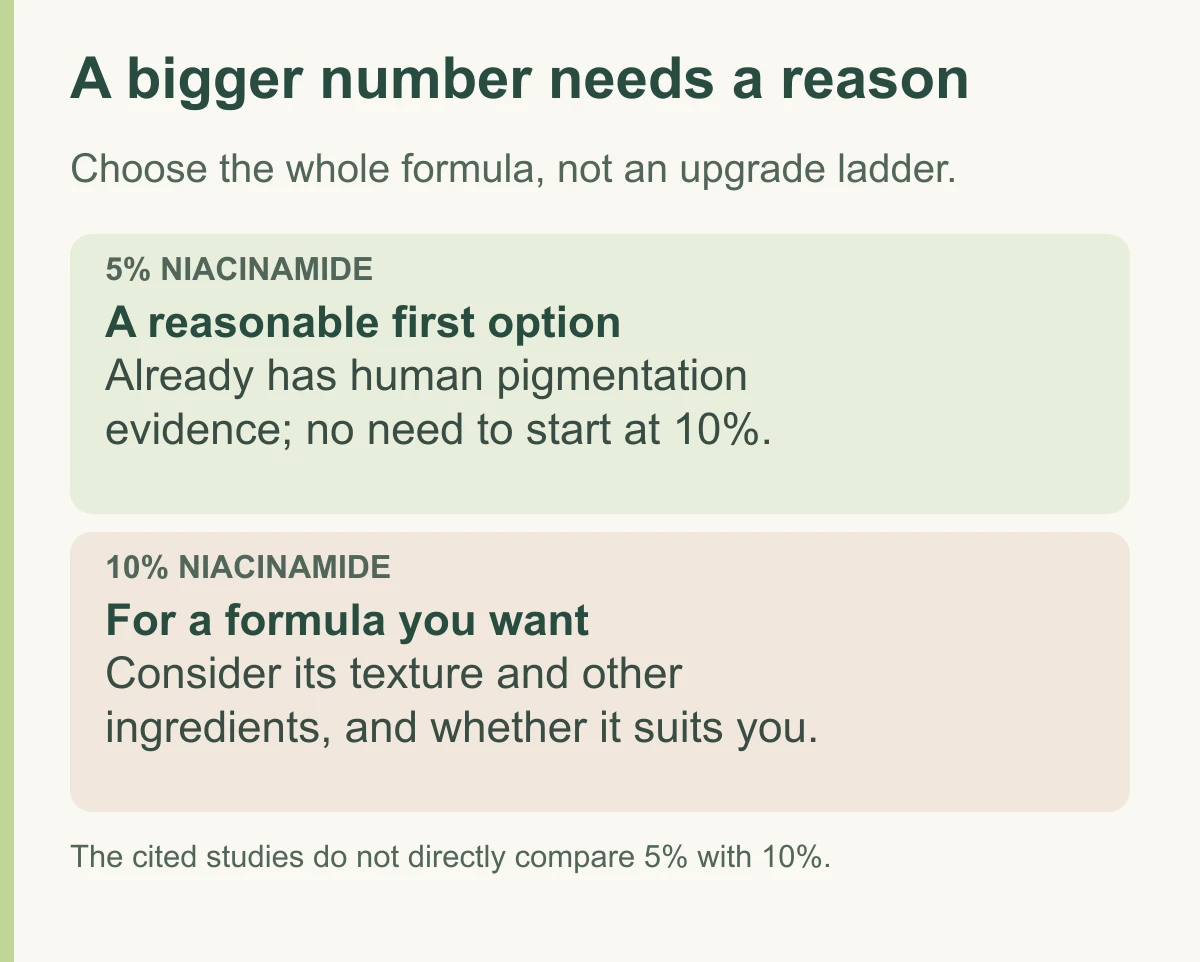
Between 5% and 10% niacinamide, I would start with 5% if you are choosing your first product. It already has human evidence for improving uneven pigmentation, so 10% is not an entry requirement for useful results. I would choose a 10% formula for a specific product I wanted and tolerated, rather than as the automatic next step.
Niacinamide is a form of vitamin B3. In a serum, the attraction is usually more even-looking tone, support for the skin's moisture barrier or help with excess surface oil. It is not an exfoliating acid: it does not work by stripping off a layer of skin. Those are reasons to consider it, but they are not reasons to assume that doubling the percentage doubles the result.
Why 5% is a useful starting point
Human research on a 5% niacinamide moisturiser found improvement in uneven pigmentation after four weeks. That gives 5% a practical reason to be considered, rather than treated as an incomplete version of 10%.
The evidence does not establish that 10% works twice as well or that everyone should increase the concentration. My preference is to begin with a formula that meets the concern comfortably. If it does that at 5%, a higher number is not an upgrade you owe your skin.
The rest of the serum changes the decision
Among the people I notice in Korea, reading the ingredient details is part of shopping for skincare, particularly when someone knows their skin dislikes a particular ingredient. I do this too: I prefer to avoid ethanol in my skincare. A percentage on the front is useful, but it does not replace knowing what else is in the bottle.
For that preference, the ingredient names matter. Alcohol, Alcohol Denat. and Ethanol refer to ethyl alcohol; cetyl, stearyl and cetearyl alcohol are different, fatty alcohols used in formulas for jobs such as softening skin and helping texture. The FDA’s explanation of alcohol labels makes this distinction clear. My choice to avoid ethanol is not a claim that every ingredient with ‘alcohol’ in its name is unsuitable.
Two products with different percentages may also differ in texture, moisturising ingredients and other actives. Moving from 5% to 10% while changing all of those things is not a controlled comparison on your face.
For example, a richer formula might suit a dry routine better than a lighter one regardless of the niacinamide percentage. A product that also contains exfoliating acids introduces another variable. If it stings, the number on the front does not tell you which part caused the reaction.
What that looks like in Korean products
Purito Seoul’s Galacto Niacin 97 Power Essence lists 5% niacinamide with 92% galactomyces ferment filtrate. It is a watery essence, so I would consider it when I wanted a light tone-care layer in a routine that already includes moisturiser.
Anua’s Niacinamide 10 TXA 4 Serum combines 10% niacinamide with 4% tranexamic acid and other ingredients, with a dark-spot focus. Tranexamic acid is another ingredient used in pigment-focused skincare. Choosing that serum is a decision about a combined tone-care formula, not simply replacing Purito’s 5% with twice the dose.
Both are Korean skincare brands, but the labels identify different products for a reason. I would start with the simpler aim of a light 5% layer when that is enough. I would consider the Anua formula when I specifically wanted its combined dark-spot approach and could use it comfortably.
When I would keep 5%, or consider 10%
If a 5% product suits your routine and you like the results, there is no automatic reason to replace it. Continuing with a useful product is a decision, not a failure to advance.
If you are new to niacinamide, 5% is a reasonable option to consider without starting at the higher of these two concentrations. It is not a promise of zero irritation. The AAD's product-testing guidance recommends trying a new skincare product on a small area before wider use.
I would consider 10% when the complete formula offers something I want, such as a texture that fits my morning routine, and it is comfortable to use. If my current 5% product already handles the concern well, I would keep it. If it repeatedly stings, I would change the product rather than increase the concentration. Our barrier discomfort guide covers that separate problem.
Two bottles do not add up to a stronger label
Layering a 5% toner and a 5% serum does not create a finished 10% product. The percentages describe their separate formulas; the amounts you apply, layering and what remains on the skin are different matters.
Extra niacinamide-containing steps can therefore repeat an ingredient without giving you a clearer reason to use them. Before increasing the percentage or adding another bottle, decide what is missing from the routine you already have.
My answer is to choose 5% or 10% for the whole product and the job it needs to do. A comfortable 5% formula does not need replacing to make the routine look more serious; a 10% formula needs a better argument than a bigger number.