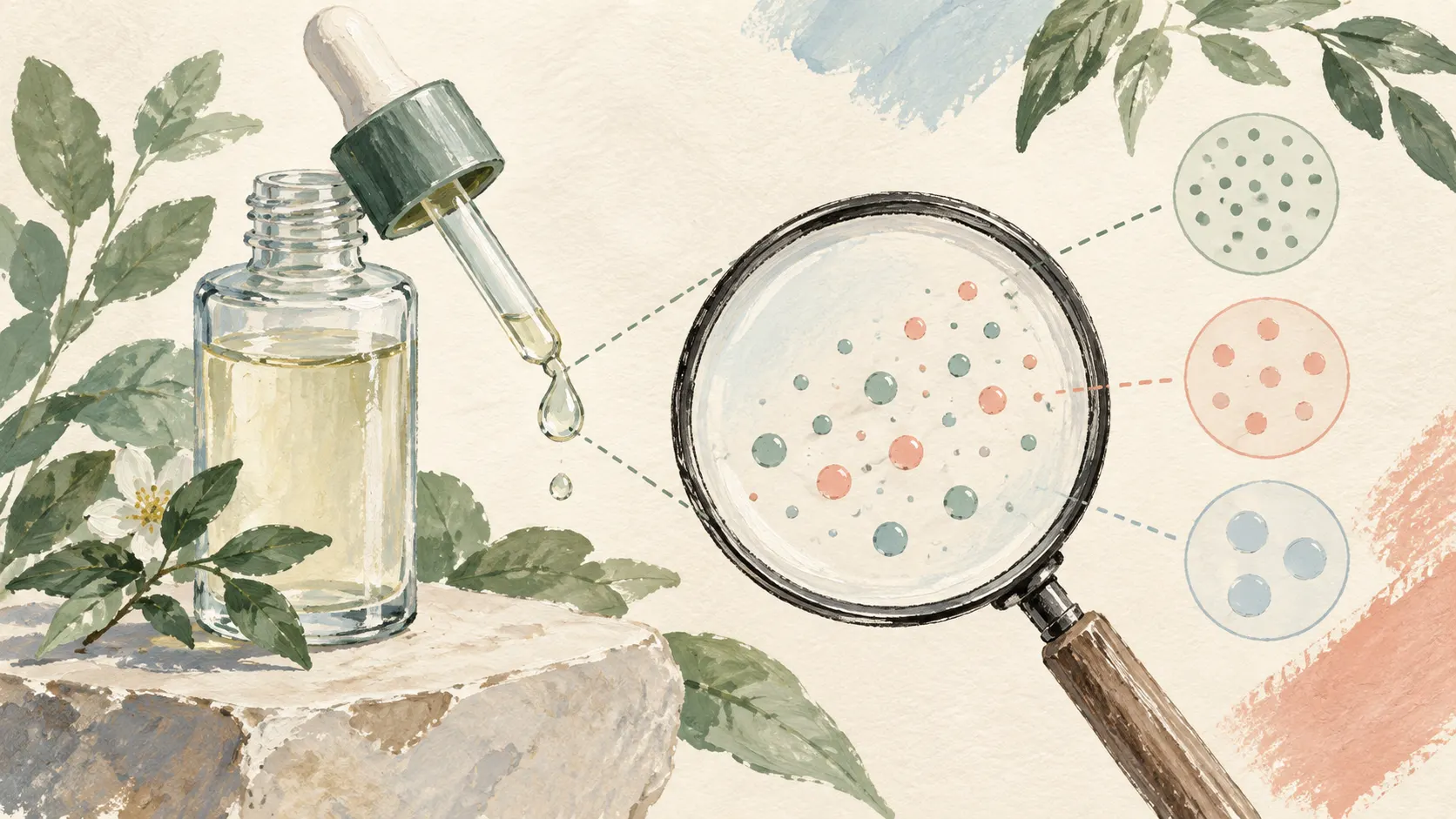
10,000 ppm is 1%. That is the easy part. The more useful question is: 1% of what?
PDRN stands for polydeoxyribonucleotide, a term used for DNA fragments. On a skincare page, its concentration may be expressed in ppm, or parts per million. A larger number tells you there is more of the named material on the stated basis. It does not, by itself, tell you which serum will work better.
So why put it in skincare? PDRN products are commonly positioned for a plumper-looking complexion and the appearance of fine lines. The useful question is whether a particular cream delivers those benefits, rather than whether DNA sounds impressive. The small eye-cream study below is one example of topical evidence; it does not establish that every PDRN serum performs alike.
There is a real Korean trend behind the label. During Olive Young's August–September 2025 sale, online searches for PDRN rose 695% versus the previous September sale, according to CJ's report. That measures shopping interest, not results. My reading is that PDRN fits Korea's interest in gradual skin ageing and clinic-inspired skincare; the concentration number gives that story a reassuringly technical-looking label.
I find ppm useful as a label-reading tool. It becomes much less useful when it is turned into a league table of skincare results.
How to convert ppm to a percentage
Divide ppm by 10,000 to get the percentage, provided both figures refer to the same material on the same measurement basis.
| Labelled concentration | Equivalent percentage |
|---|---|
| 100 ppm | 0.01% |
| 1,000 ppm | 0.1% |
| 5,000 ppm | 0.5% |
| 10,000 ppm | 1% |
| 20,000 ppm | 2% |
So 10,000 ppm and 1% are two ways of writing the same proportion. The extra zeros make the label longer; they do not make the ingredient more concentrated than 1%.
These conversions do not give the total milligrams in a bottle labelled in millilitres. That calculation would also need the relevant density and a clear definition of what the concentration counts.
A real label example
Medicube, a Korean skincare brand, lists Sodium DNA at 100 ppm in its PDRN Pink Vita Coating Sheet Mask ingredient list. That stated Sodium DNA figure converts to 0.01%.
An ingredient name such as Sodium DNA is also not a complete specification of the DNA material. The name alone does not establish its fragment-size range or make every product using it equivalent.
An ingredient blend and its active content are different numbers
A formula can contain a mixture made from water, a carrier and a smaller amount of the ingredient being promoted. The percentage of that mixture is not necessarily the percentage of the promoted ingredient itself.
Here is a hypothetical calculation, not a claim about a particular brand:
- A supplied blend contains 1% of an active ingredient.
- The finished formula contains 10% of that blend.
- On the same mass basis, the finished formula contains 0.1% of the active ingredient, or 1,000 ppm.
The 10% blend figure is perfectly possible. It simply answers a different question. Before comparing two headline numbers, I would want to know whether each counts the DNA ingredient or the whole supplied blend, and whether it refers to the finished product.
Ingredient order cannot fill in a missing concentration
Under EU cosmetics labelling rules, ingredients below 1% may appear in any order after those above 1%. A position near the end of a list therefore cannot tell you whether a DNA ingredient is present at 100 ppm or 1,000 ppm.
The list can identify what is declared. It cannot supply a missing exact figure, nor the full technical specification of a raw material.
What would persuade me beyond the number?
A useful product explanation would connect a clearly defined concentration to evidence for that finished formula used in the relevant way. A result involving an injection, a raw ingredient or a different delivery method does not automatically describe a serum applied to intact skin. Our PDRN skincare explainer covers that distinction in more detail.
For example, a 2026 topical study tested an eye cream containing 0.1% PDRN-850K, equivalent to 1,000 ppm, in 31 women over 28 days. That specifies a preparation, formula and use, rather than a universal winning concentration. It does not establish that every 1,000 ppm cosmetic works alike or that 10,000 ppm would work ten times better.
Between a clear, well-described formula and one selling mainly a bigger ppm number, I would choose the clear formula. For everyday hydration, glycerin, panthenol and the moisturising texture may be more useful to understand than the DNA headline. For a fine-line claim, evidence on the finished topical product would decide my interest.
This is an affiliate link. If you buy through it, I may earn a commission at no extra cost to you.
You can browse Medicube’s range at Olive Young Global. This is a brand selection. I did not verify a listing for the exact Pink Vita Coating Sheet Mask used in the label example above.
I would use ppm to decode the label, then choose on the full formula and relevant evidence. A product that explains its ingredient and gives me a reason to use it is the stronger purchase candidate. More zeros are not that reason.