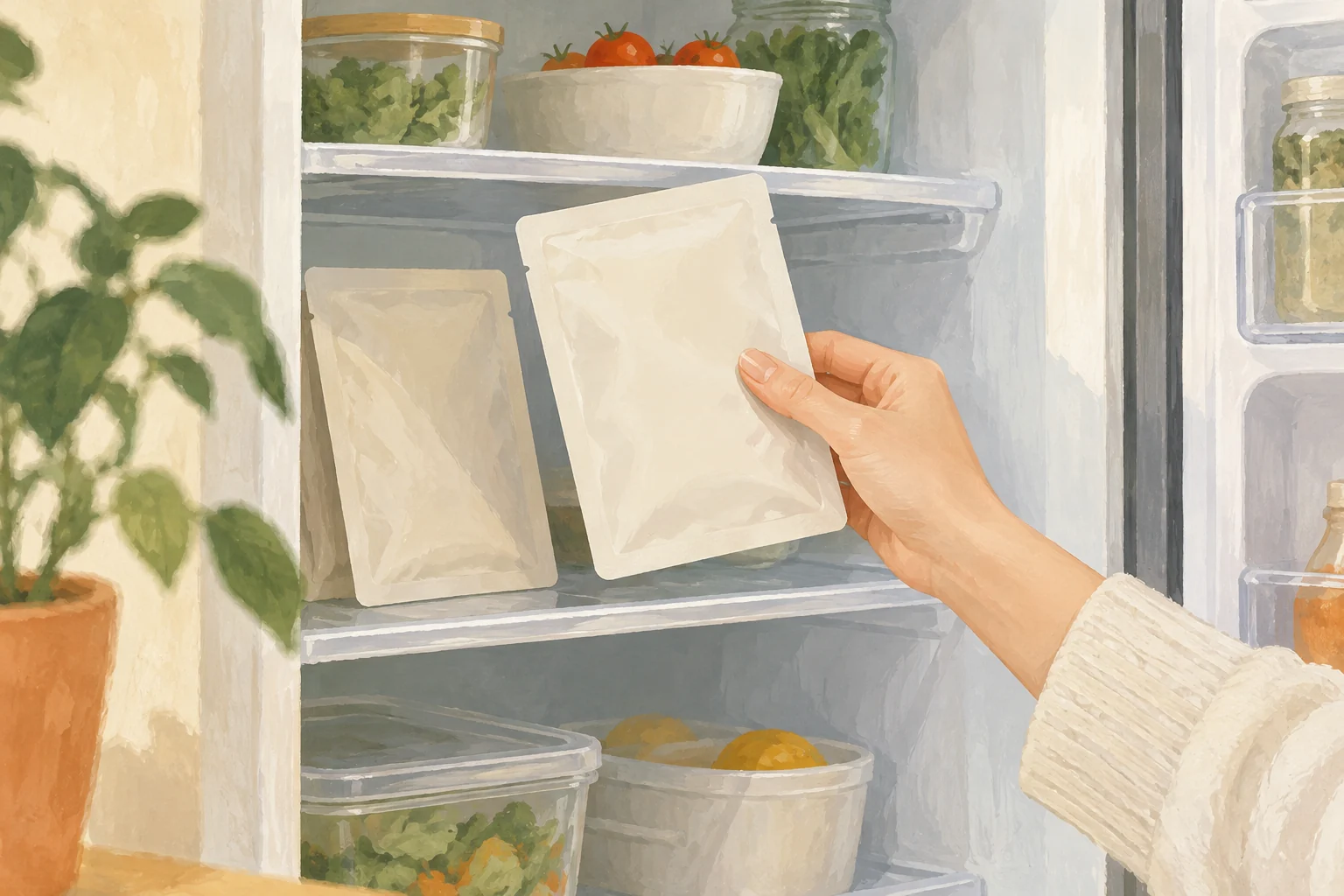
Most skincare does not need a dedicated fridge. A shaded cupboard at the temperature specified on the product is usually a better starting point than moving your whole routine into a miniature refrigerator.
Keeping sheet masks in the fridge is familiar to me: I do it, and so does my family. But that habit does not mean every bottle in a skincare routine needs the same treatment.
A cool sheet mask can be enjoyable. Cooling a product for the sensation and refrigerating it because the formula requires it are two different reasons to open the fridge door.
Does colder skincare work better?
Cold can change the experience of applying a product without making its skincare ingredients more effective. Cleveland Clinic's guidance on skincare fridges makes that distinction: a cool product can feel pleasant, but a dedicated fridge is generally unnecessary, and most skincare is made for room-temperature storage.
Enjoying that refreshing feeling is a perfectly good reason to prefer it. It does not establish better hydration, deeper absorption or a longer life for everything you put on the shelf.
What about Korean sheet masks?
Sheet masks are an obvious candidate for cooling because you hold a wet sheet against your face for several minutes. The useful question is whether a particular mask allows a brief chill, needs continuous refrigeration or is intended for ordinary room-temperature storage.
Beauty of Joseon, a Korean skincare brand known for combining traditional ingredients with modern formulas, offers a useful example. Its general storage guidance is room temperature, away from direct sunlight. In a separate cooling tip for its Centella Asiatica Calming Mask, it suggests a roughly thirty-minute spell in the fridge before application.
That is a brief cooling step before use, rather than a requirement to keep a whole supply refrigerated. For that particular tip, set aside the sealed mask you intend to use. Other masks may have different instructions, so the packet in your hand gets the final say.
Keep the application time separate, too. A mask feeling cool at the beginning is not a reason to wear it longer than instructed. If you are wondering why a hydrogel mask turns transparent, our Biodance mask guide answers that question; the colour change is a different issue from where to store the packet.
Serums need a product-specific answer
It is tempting to make a tidy list: vitamin C in, retinol in, moisturiser out. I would not organise a routine that way. The ingredient name on the front is not the whole formula, and storage directions can be more specific than the category.
There are real exceptions to the ordinary room-temperature advice. The Ordinary's Granactive Retinoid 2% Emulsion, for example, explicitly says to refrigerate after opening. That is an instruction for that serum, not a rule for every product containing a retinoid.
If a product says “store at room temperature,” leave it in an appropriate shaded place. If it says “refrigerate after opening,” follow that requirement. If your home regularly gets hotter than the stated storage range, ask the brand about that actual situation instead of assuming any colder setting will solve it.
For an unclear label, ask the brand a specific question: “Can this product be refrigerated after opening, and at what temperature?” That gives you something useful to act on.
What would make a fridge worthwhile?
Think about the products you would actually keep in it and how often you reach for them. A refrigerator takes up space, needs power and gives you another surface to keep clean. If the only intended resident is a sheet mask you use once a fortnight, I would keep the cupboard and the counter space.
If you already enjoy cooling compatible masks or mists frequently, having them near your dressing table may make the routine more convenient. Choose an appliance with a stated temperature range that suits those products, rather than buying purely for its size or colour. A food fridge and a cosmetic fridge are not automatically interchangeable simply because both feel cold.
I would also leave foundation out of this experiment. Makeup needs to spread smoothly, and cooling can change how readily it applies. There is little point in making a cushion harder to use while trying to give your routine a supposedly better home.
For most readers, the useful upgrade is a suitable storage spot and a quick check of the instructions. Cool a compatible mask if you enjoy it, refrigerate a formula that requires it, and let the rest live where it was designed to live. A Korean skincare routine does not need its own kitchen extension.