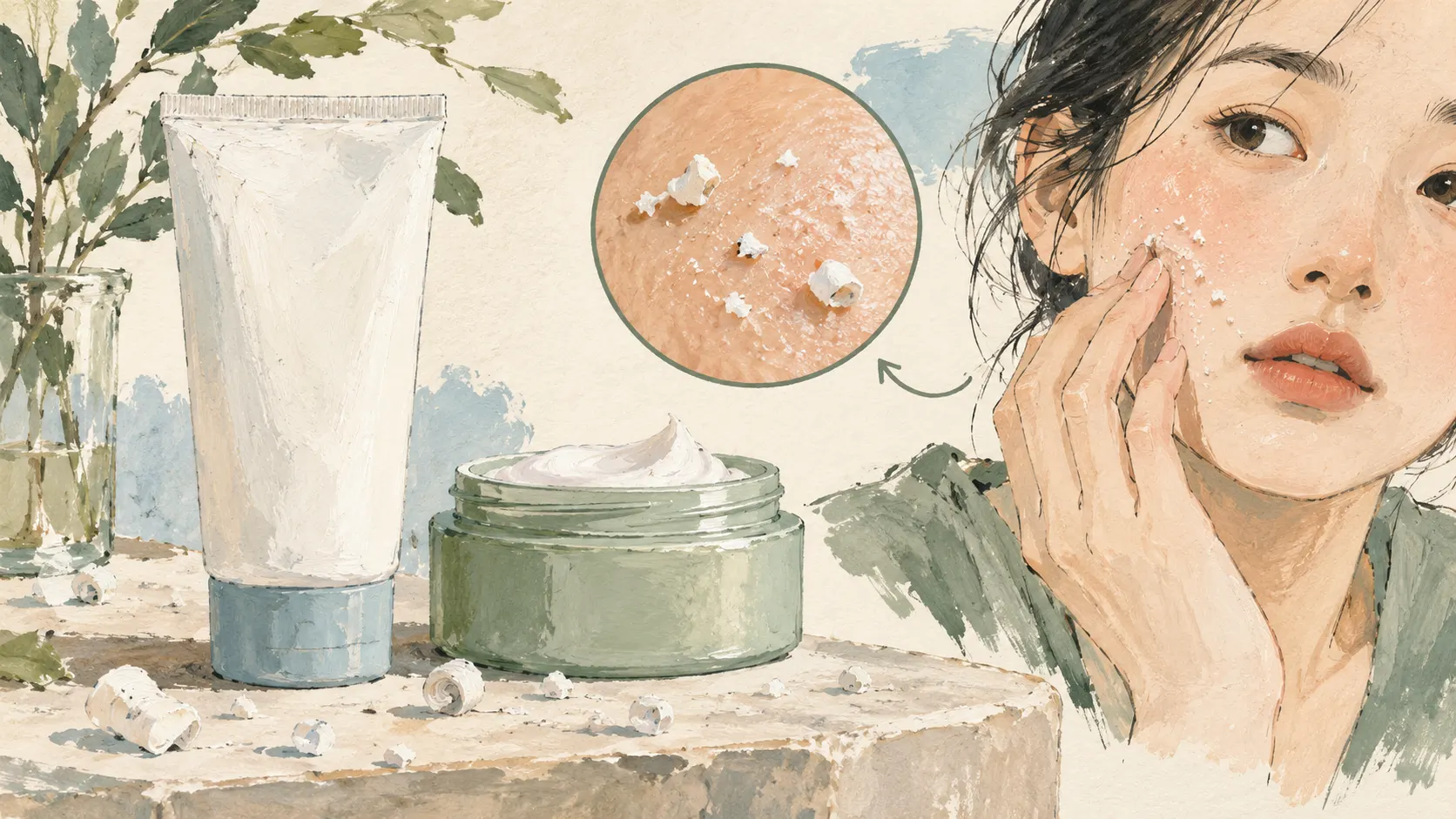
If your Korean sunscreen rolls into little flakes, change the optional layers or application before reducing the sunscreen amount. A smoother finish obtained by using too little SPF solves the wrong problem.
Pilling is product rolling or balling on the surface as layers are applied or disturbed. It is not automatically dead skin, a counterfeit product or proof that the sunscreen has stopped working. The useful first question is when it starts: during sunscreen application, when makeup goes on, or later during a touch-up.
Start with the moment it rolls
| When you first notice it | A useful change to try |
|---|---|
| While spreading sunscreen over several skincare layers | Keep the instructed sunscreen amount and remove one optional layer from the next application |
| Only while rubbing repeatedly over the same area | Spread evenly with less repeated back-and-forth rubbing; follow the sunscreen's directions |
| When foundation goes onto an otherwise smooth sunscreen layer | Give the sunscreen its instructed settling time and apply makeup with less dragging |
| During a later touch-up | Look at the accumulated makeup and skincare layers; avoid repeatedly scrubbing loose product across the face |
These are ways to investigate a combination, not guarantees that a particular ingredient is responsible. Change one thing at a time so that an improvement tells you something.
For example, if the same sunscreen behaves better after you leave out a hydrating serum, that identifies a possible layering issue. It does not prove that serum is badly formulated or that all serums containing its headline ingredient will pill.
Spread evenly, then stop working the same area
Repeated rubbing can disturb the layers you have just applied. Spread sunscreen evenly as directed, then avoid going back over the same patch again and again to make it feel dry. When makeup follows, a light tapping motion can move the base less than dragging a puff across it.
Research on skincare pilling supports paying attention to application movement. It does not provide a fixed number of pats or tell you how much SPF remains after visible flakes form. The useful adjustment is less unnecessary friction while still covering the skin evenly.
Simplify the optional steps
A toner, essence, serum and primer can each have a purpose. They can also leave you trying to make four optional layers cooperate before sunscreen and foundation arrive.
If several liquids are doing much the same job, try leaving one out. Our hydration-layering guide explains why more layers are not automatically more useful. If your skin needs moisturiser, keep that need in view rather than stripping the whole routine down to a dry surface.
Allow each necessary layer to settle according to its directions. There is no universal waiting time that makes every combination work, and this is not a reason to keep rubbing until the products appear to vanish.
Also separate pilling from discomfort. Flakes that appear as product rolls are a different observation from skin that is persistently stinging or inflamed. If the latter is the issue, our barrier discomfort guide is more relevant than finding a foundation technique to disguise it.
For a practical next-morning test, keep the same cleanser, necessary moisturiser and sunscreen, but leave out one optional serum or primer. If the rolling happens only when foundation is added, leave the skincare alone for that test and change how you apply the foundation. That is a smaller and more informative change than buying a new full routine.
Ingredient blacklists are a blunt shortcut
“Never put a water-based product over a silicone-based one” sounds satisfyingly simple. It is not a reliable diagnosis from two ingredient lists. Finished products contain mixtures, and compatibility depends on the formulas and how you use them.
Dimethicone is a silicone used for slip, a smoother feel and reducing moisture loss. That does not make it an automatic cause of pilling: the amount applied, the complete formulas and how you layer them matter more than spotting one silicone name.
The presence of dimethicone alone cannot tell you whether your combination will roll. Nor can the fact that a sunscreen is Korean. I would keep notes on the specific pair that causes trouble rather than build a blacklist around a whole ingredient family or country.
If removing unnecessary layers and changing the movement do not help, a different sunscreen or makeup formula may be the more sensible choice. The aim is a combination that lets you apply sunscreen properly, not a routine you have to negotiate with every morning.
What about the protection after it pills?
You cannot calculate the protection left from the size of the flakes or how smooth the skin looks. If the sunscreen layer has visibly lifted into clumps or left patchy areas, do not treat a foundation touch-up as proof that protection has been restored. Re-establish even sunscreen coverage according to the product's directions before relying on it outdoors.
The AAD's application guidance recommends generous application and reapplication every two hours outdoors, and after swimming or sweating. Cosmetic neatness does not replace those instructions.
My rule is to change the combination around sunscreen while keeping its job intact. Identify when the rolling begins, simplify one optional step, reduce needless friction and choose another pairing if necessary. The finish should accommodate proper sun protection, rather than ask it to disappear.